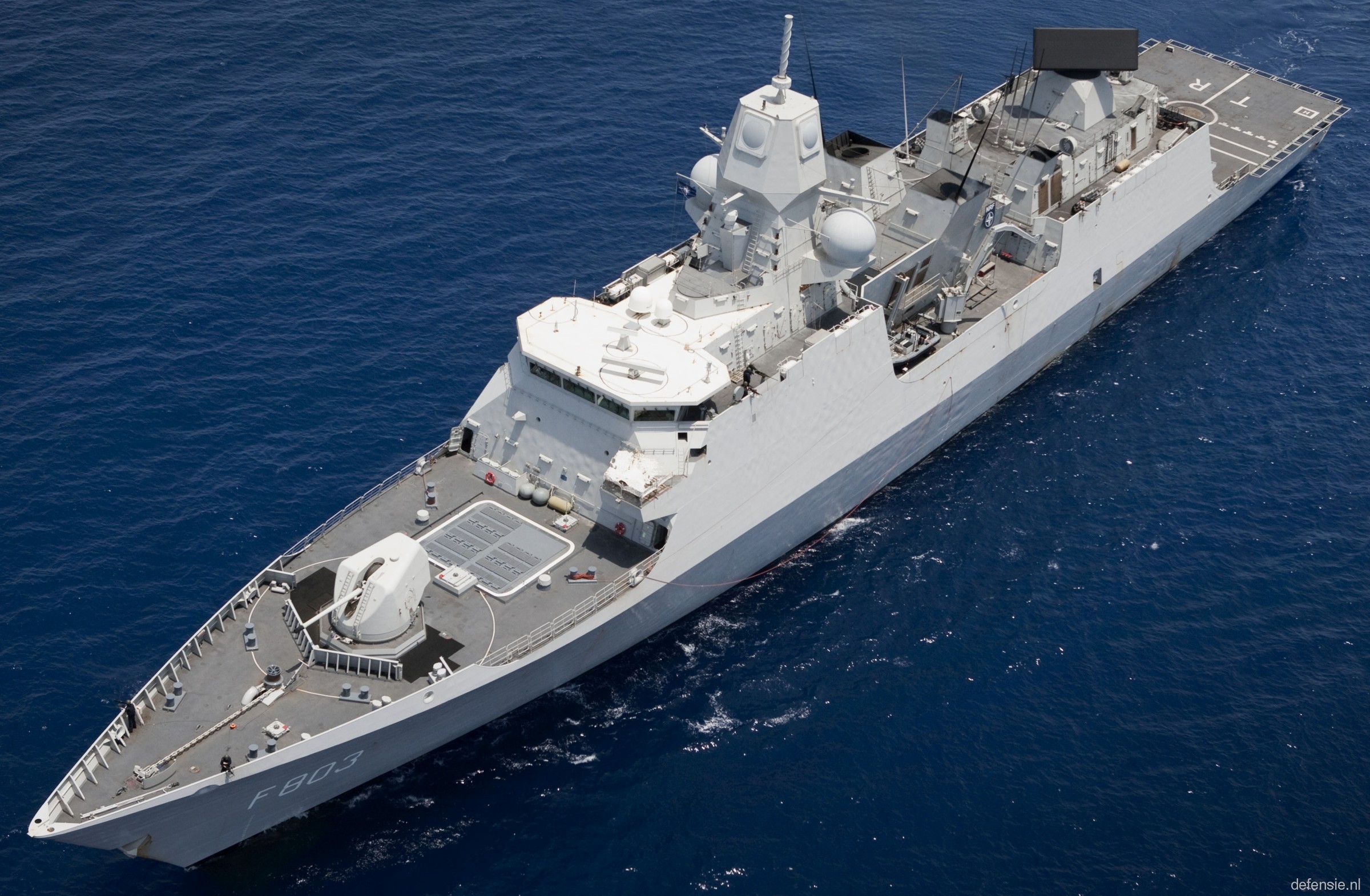
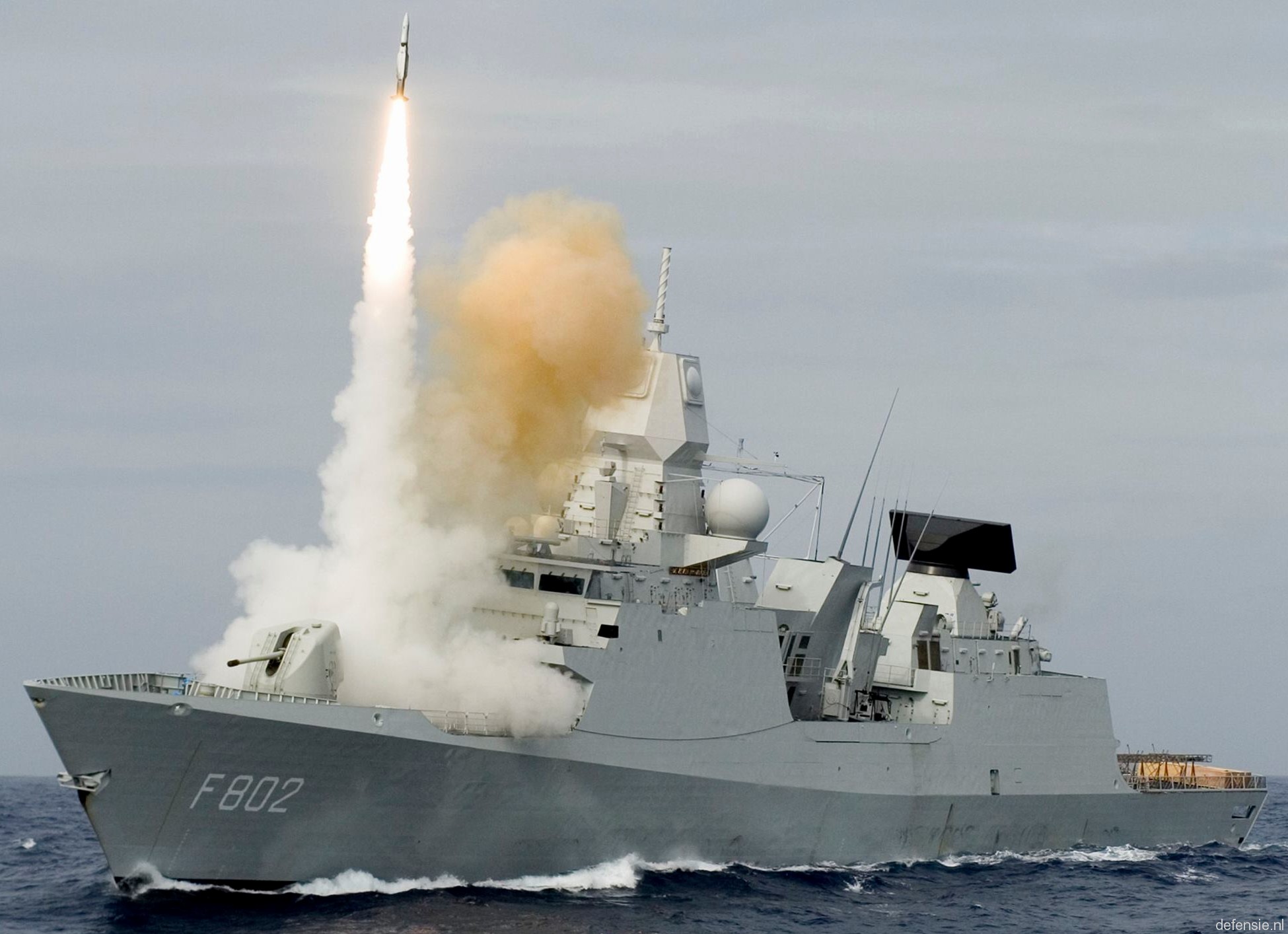
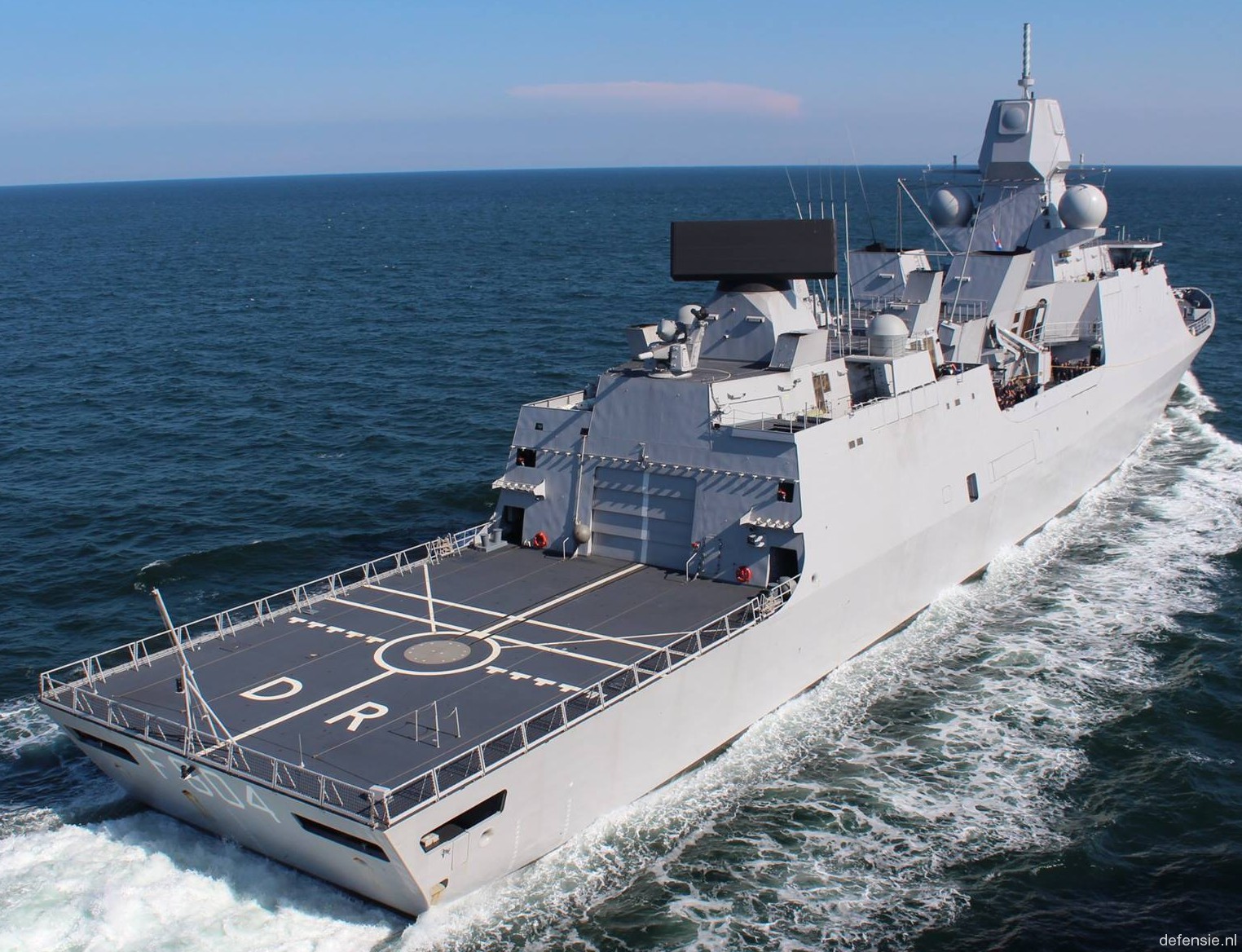
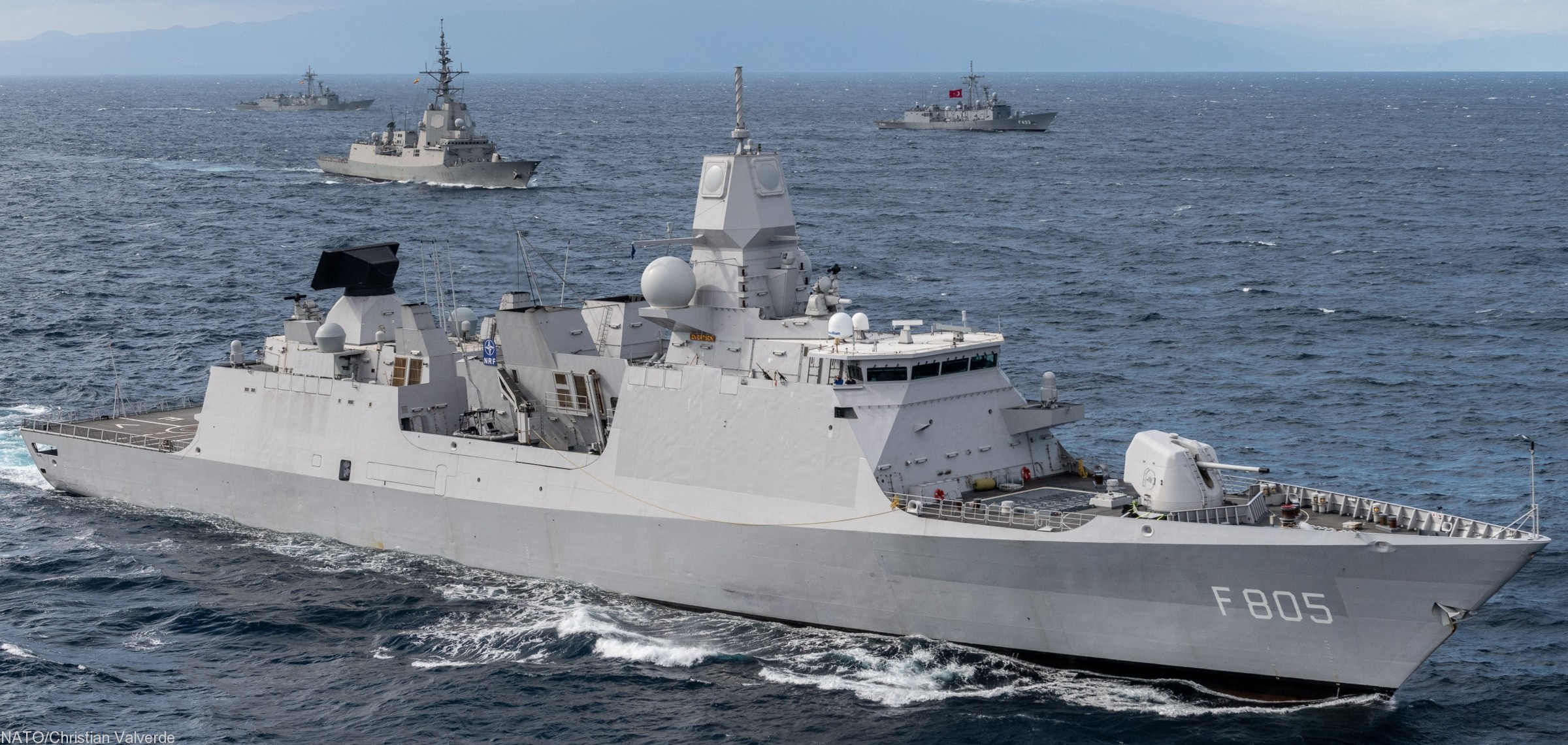
ADCF (Air Defence and Command
Frigate) and ADF (Air Defence Frigate)
(LCF - Luchtverdedigings- en
Commando Fregat):
The Dutch AD(C)Fs were build as a replacement for the former
Tromp-class guided missile frigates of the Royal
Netherlands Navy, and (in the guise of ADF) as replacements
for the
'Standard'/Kortenaer-class frigates. The ADF is
equal in capabilities and appearance to the ADCF, except for
the lack of dedicated Command facilities.
These ships are being build as part of a tri-partite
building program between the Spanish Armada, the German
Marine, and the Dutch Royal Navy. Instead of the failed
Horizon program which involved Italy, France, and Great
Britain, this program concentrates upon the Ship Platform
and systems, rather than on combat systems and weaponry. The
other ships being developed in this program are the Spanish
F-100, with SPY-1 and Aegis combat system, and the German
F124, which also has the APAR and SEWACO combat system.
The name of "Frigate" for these ships is actually a
misnomer: With a displacement of over 6,000 tons they are
destroyers in all but name. When the first of the class
enters service, it will arguably be the most advanced ship
in this size in the world. The Royal Netherlands Navy has
apparently sacrificed upgrades to some of its existing
warships in order to provide some of the needed funds for
this class of four ships.
In keeping with the general trend, the ships have extensive
Stealth features designed into them. Their large slightly
angled slab sides give them a bit of the look of the French
Lafayette frigates, although the ADCF design is considerably
bigger and capable. Survivability has been a great concern
in designing the ships, and they are subdivided into seven
main compartments. When hit in one of these compartments
ventilation, fire control systems, and power will still be
available in the other compartments. In order to achieve
this all necessary systems have full-sized backups.
At first it appeared that the main engines for the ships
would be the new Rolls Royce WR-21, which will also be
deployed on the Royal Navy's Type 45 Destroyers.
Unfortunately the WR-21 was not available in time
(apparently it won't be available until 2007), so for now
the main engines will be Rolls-Royce SM-1C 'Spey' gas
turbines, which are a good design which unfortunately is
getting on in years. However, when the ships were designed
the engine room was designed with the WR-21 in mind, and
there is room for these turbines. It is likely that the
ships will receive the WR-21 later on in their operational
lives, a move that would substantially increase fuel
efficiency and raise engine power.
Secondary engines have always been two Wartsila diesel
engines, and the engines drive two adjustable counter
rotating propellers.
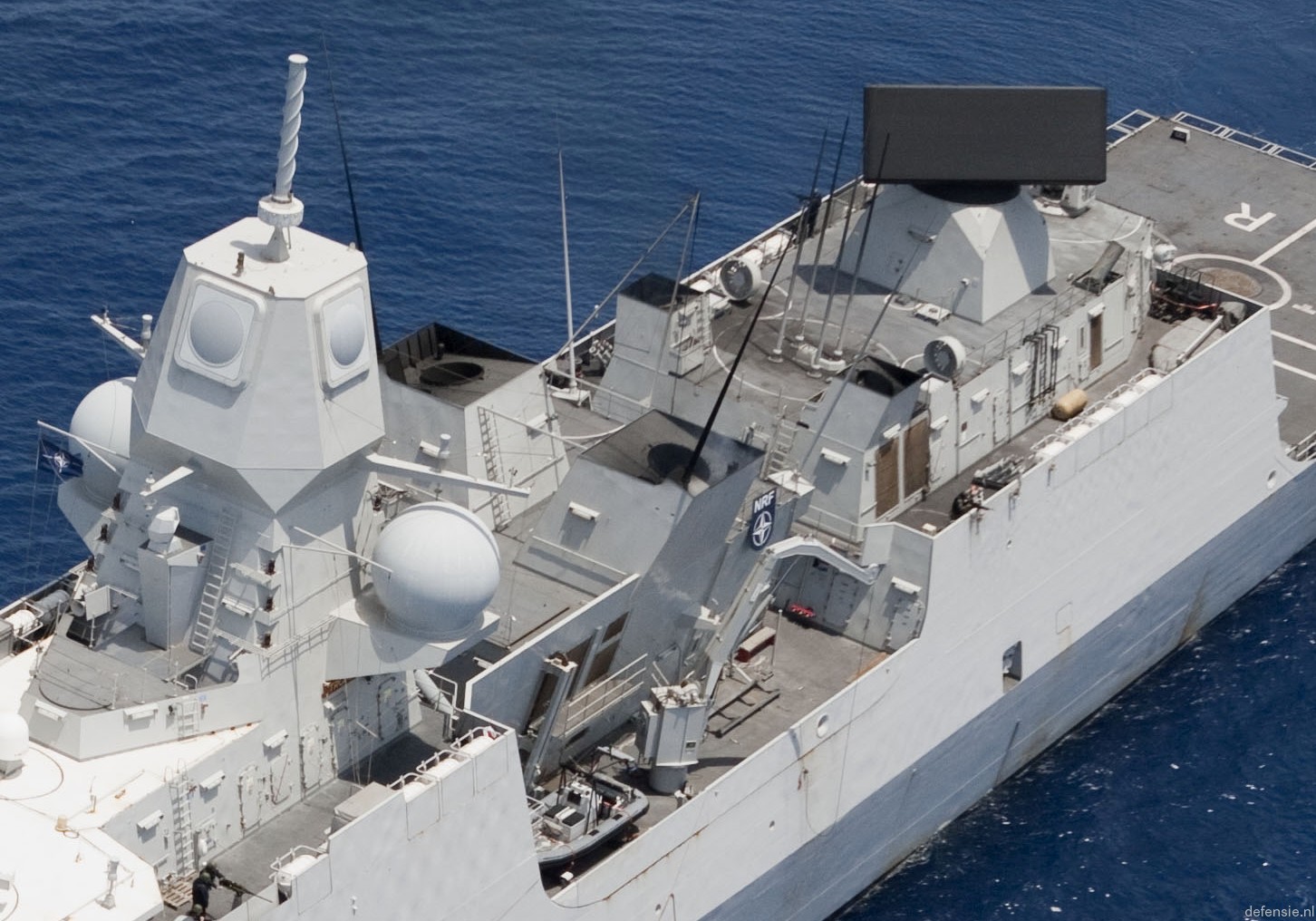
For sensors, the design features the APAR system, which has
been build and designed by the Netherlands, Germany, and
Canada. This is a high-powered Active Phased Array Radar,
which is smaller, yet considerably more powerful, than the
American SPY-1 phased array radar. It can track up to 250
targets at one time, and at the same time can function as a
illumination radar for up to 16 targets (with 32 missiles in
the air), removing the need for separate illumination
radars. Because of its relatively small design it was
possible to locate the four APAR panels in a single
structure high above sea level. In a move which cause some
last-minute delays the Dutch decided to have the APAR mount
redesigned, so that in the future the guidance equipment for
Standard TBMD missiles can be fitted. The long-range search
radar is the SMART-L phased array 3D radar. This radar is
not stabilized, but the emission-angle of the radar is
adapted to the current sea state and angle. It has a range
of up to 400 km, and can track up to 1000 targets. Mounted
above the APAR, at the very top of the ship is a Sirius
long-range dual band infra red seeker, with a maximum range
of roughly 30 km. Mounted on the hull is an Atlas Electronik
active sonar.
MISSIONS:
The ships are presented as the first line of naval defense
against antiship missiles (diving, cruise, sea-skimming,
supersonic) incoming at supersonic speed from any direction,
highly manoeuvring, in all weather conditions and in a
severe electronic warfare environment, as well as aircraft
attacks.
The main tasks of these ships are to provide a local area
air-defense capability against airborne targets for a
task-group, and to provide that same task group with
dedicated command facilities.
The missions assigned to
this class of frigates are:
Primary:
Anti-Air Warfare
(to provide local area air defense of a task group against
airborne targets, in particular against saturating anti-ship
missile attacks). To provide a Flagship function for a
Taskforce or a Flotilla (This applies only to the ADCFs, NOT
the ADFs, which will lack command facilities).
Secondary:
Anti-Surface Warfare
(to provide a significant fire power against surface targets
by surface-to-surface missiles and guns as well as the
multi-function shipboard helicopter.
Anti-Submarine Warfare
(to provide an anti-submarine defense by using a heavy
ASW-helicopter)
Naval Fire Support
(to provide fire support for amphibious landings using the
127mm gun)
|
Weapon- & Combat
Systems:
ANTI-AIR WARFARE (AAW):
The AAW system of the ADCF/ADF is centered on a Thales
SEWACO X Information management system. This is one of the
most advanced systems of its kind, and integrates all
sensors and weapons into one system, using a network of
fiberglass cables and a series of high-powered computers.
APAR multifunction phased
array radar:
The APAR (Active Phased Array Radar) by Thales contains four
active phased array antennas with 3200 modules each, which
together provide a 360 degrees azimuth coverage. Some other
features of the system are multi-function capability,
digital Doppler processing, digital pulse compression
techniques, graceful degradation and flexible waveform
generation. APAR operates in I/J-band, which makes the radar
an excellent sensor for the detection of sea-skimming
missiles. The APAR system has one main waveform generator,
plus two additional waveform generators to provide missile
guidance links and target illumination in the terminal phase
of engagement. Each array can generate up to four beams for
16 simultaneous engagements and 30 SM-2 and ESSM missiles in
the air. Instrumented range is 150km in air search and 75km
horizon search with elevation coverage up to 70 degrees and
a capacity to handle 250 tracks.
SMART-L Long Range early
warning radar:
This is a volume-search early warning long-range air search
radar, which has been designed by Thales. It is a derivative
of the smaller SMART-S, using an LW-09 solid-state
transmitter. It uses an 8.2m electronically stabilized
antenna scanning at 12 rpm to an elevation of 70 degrees.
SMART-L provides range, bearing, elevation, and target
velocity on each scan. Low observable targets can be
detected at 55km and a conventional target beyond 100km.
Maximum instrumented range is 400km. The ADT track file can
carry up to 1000 air, 40 surface and 32 jammer tracks
simultaneously. SMART-L is integrated with the Scout radar
for surface surveillance.
Scout Surface search radar:
This is an X(I) band LPI (Low Probability of Intercept)
surface search and navigation radar designed to be difficult
to detect by enemy ESM. It uses a 1.8m antenna and scans at
24rpm. A 1m2 target can be detected at 5.5nm, a 100m2 target
at 15.6nm. Scout is expected to detect a corvette-sized ship
at horizon range and a 5m wooden or GRP boat at 8nm. The
maximum-instrumented range is 24nm. Scout has a power output
of about 0.001 W, compared to about 20-kW for a conventional
radar. Counter detection range for ESM is estimated at
1.5km.
Sirius Long range dual band
infra red seeker:
This is a high-powered Infra Red surveillance system. It is
very useful for locating sea-skimming missiles. It is
designed and build by Thales. Sirius is a dual-band IR
detection and tracking sensor with an 8-12 micron and a 3-5
micron IR camera on a pedestal. The former has a window
which elevates to 14 degrees and the latter a window which
elevates to 3 degrees. Scan rate is 53 rpm and an airplane
can be detected at up to 15km, a missile at up to 12km. The
system can carry over 500 tracks and provides automatic
alerts on the 32 most threatening tracks with a false alarm
rate of less than 1/hr. SIRIUS provides data directly to the
SEWACO Combat Data System as digital data to the databus and
video to the video bus. Each band can be processed
separately providing three different outputs - each band
individually or a combined output.
Mirador Trainable electro
optical observation system:
This is a high-powered Optical and Infra Red surveillance
system. Mounted on the APAR mast, it is designed and build
by Thales. Unlike Sirius, which is an IR-only system which
functions in a continuous scanning mode, Mirador is a
combined Optical/IR system, which will be used to help the
crew to detect, identify and observe targets. The main
sensor of the Mirador is the ALBATROSS infrared camera,
which is a 3rd generation Focal Plane Array camera made by
Thales. The Mirador array will be fully integrated into the
SEWACO system, and can be used to provide targeting data to
the system. Mirador can operate in a air search mode and in
a automatic tracking mode, as well as be directed to observe
targets from any workstation on the bridge and C&C. Mirador
has been mainly added to the ADCF to improve target
acquisition and recognition during brown water operations,
but will also be of help with navigational tasks, especially
in bad weather conditions when visibility is poor.
MK-41 VLS modules:
These are 8-cell vertical launch modules designed and build
by United Defense which are capable of storing and launching
an incredible variety of missiles. In the case of the ADCF,
the five MK-41 modules will be filled with 32 SM-2 and 32
quad-packed ESSM missiles.
Standard Missile-2
surface-to-air-missiles:
The Standard Missile-2 Block IIIA is a member of the
Standard family of missiles which has been around for
decades. The Standard missile is a solid propellant-fueled,
tail-controlled, surface to air missile fired by surface
ships. It is designed to counter airplanes and high-speed,
high-altitude anti-ship cruise missiles. Later versions like
the Block IIIA have greatly improved propulsion, electronics
and warheads and have added low-level capabilities,
resulting in virtually new missiles. The missile is fired at
its target in a fuel-efficient ballistic trajectory, and
only in the last stage of the trajectory is the target
illuminated by the available illumination radar (APAR for
the ADCF), after which the passive seeker head of the SM-2
steers the missile onto its target.
The SM-2 Block IIIA itself is a much-improved version of the
Standard SM-1 surface-to-air missile with an improved motor,
improved seeker and a programmable autopilot for mid-course
guidance. Range is double that of the SM-1 missile.
ESSM surface-to-air-missiles:
The ESSM (Evolved Sea Sparrow Missile) is a short-range
surface to air missile, with extreme maneuverability and an
excellent low altitude performance. When fired it
immediately aims for the target illuminated by the available
illumination radar (APAR for the ADCF), after which the
passive seeker head of the ESSM steers the missile onto its
target. Four ESSMs can be packed into a single MK-41 cell,
making them very space efficient.
Ship's air self-defense:
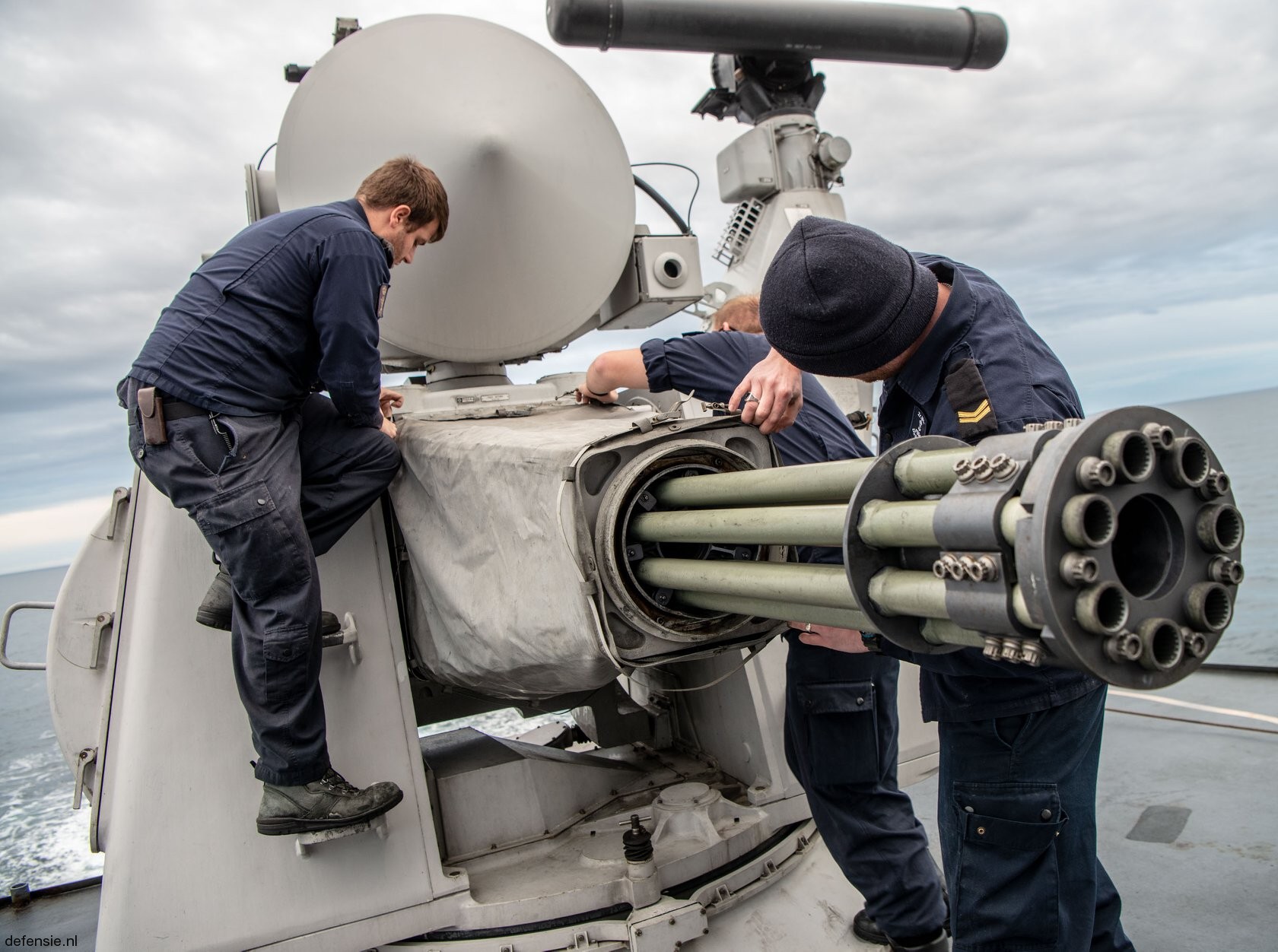
Goalkeeper 30mm CIWS:
The Goalkeeper is a stand-alone Close In Weapon System meant
for engaging incoming sea-skimming SSMs. They are build by
Thales. The Goalkeepers on the ADCF are incorporated into
the Sewaco X system for initial guidance, but retain an
independent search capability. The gun itself is the General
Electric GAU-8 seven barreled 30mm Gatling gun, and has an
effective range of up to 2000 meters. The ammunition is made
up of high velocity discarding sabot armor penetrators. With
their ammunition supply, each goalkeeper can fire four
bursts before needing to be reloaded. The Goalkeepers have
improved software to improve their capability to engage
dodging targets.
Thales Sabre ESM/ECM:
Sabre ESM is a development of Thales's UAT system and
represents one of the most advanced integrated naval EW
systems available worldwide. The Integrated EW suite
combines a multi-band ESM system with a Digital Radio
Frequency Memory (DRFM)-based phased array jammer, which is
capable of tracking and jamming multiple simultaneous
threats co-coordinated by a powerful techniques generator.
The Sabre system will have two main Phased Array Emitters,
one will be located on a small sponson just below the bridge
on the left corner of the superstructure, and one located on
the right corner of the hangar.
United Defense Mk 36 SRBOC
Chaff mortar:
A set of mortars, capable of firing Chaff and Flares to
confuse and divert incoming missiles. With minimal
modification capable also capable of firing the 'Nulka', a
rocket propelled decoy. It is unknown if the MK-36 system on
the ADCF will have the capability to fire the 'Nulka'.
ANTI-SURFACE WARFARE
(ASuW):
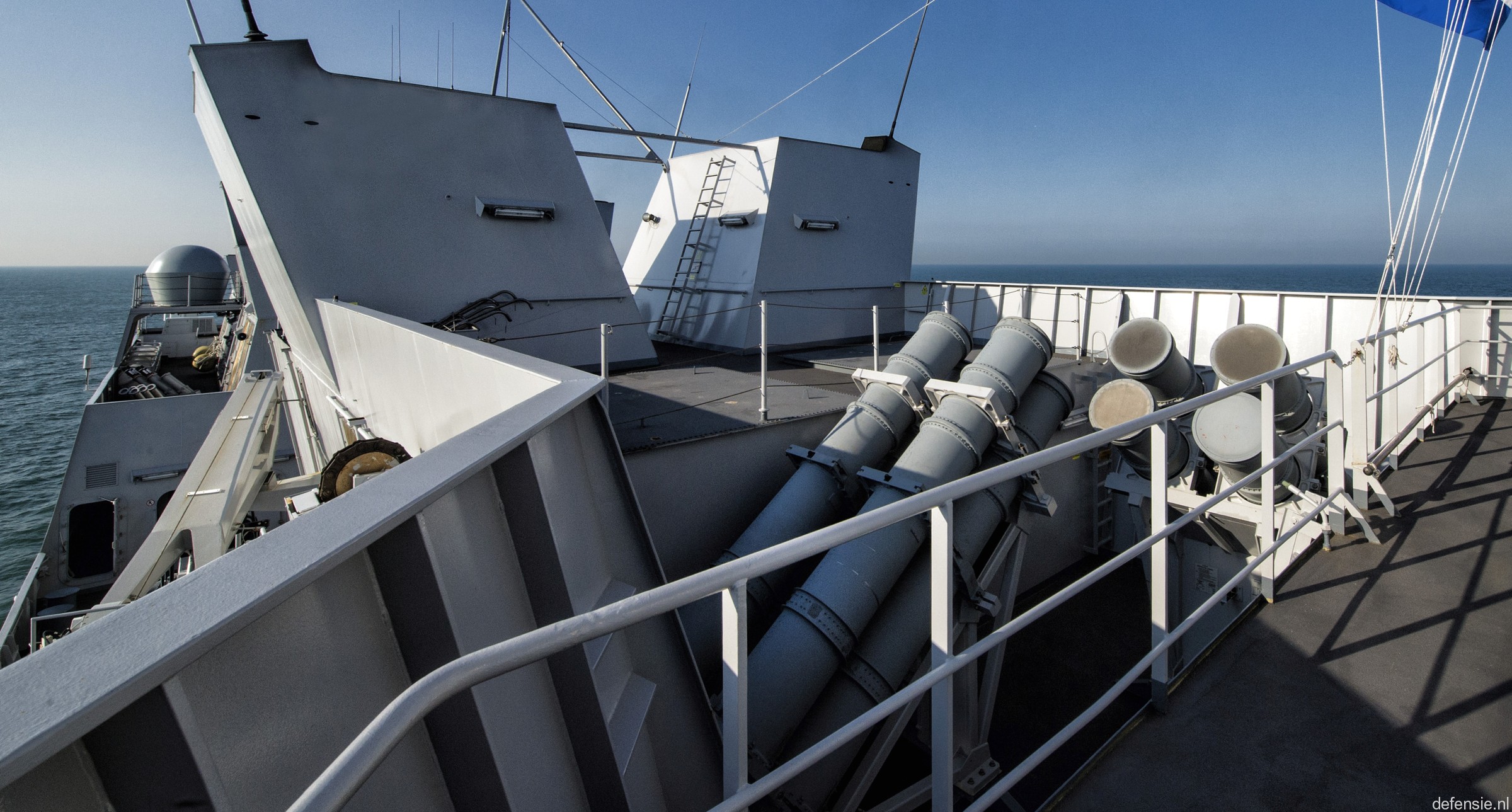
RGM-84 Harpoon SSM:
Harpoon is a sea-skimming cruise missile designed for
anti-ship use, which is made by Boeing. It features an
active radar seeker head, and a 488-pound high explosive
penetrating warhead. It uses a turbojet for cruise flight,
and a solid propellant booster for launch. Maximum range is
roughly 90 km at 855 km/ph. The Block II version, which
should be available around 2002, will incorporate GPS
guidance and improved software to enable the use of Harpoon
in a littoral environment, and as a Land-Attack missile. The
Harpoon missiles aboard the ADCF are packed into disposable
launch containers. Four containers make up a single launch
unit, of which the ADCF has two.
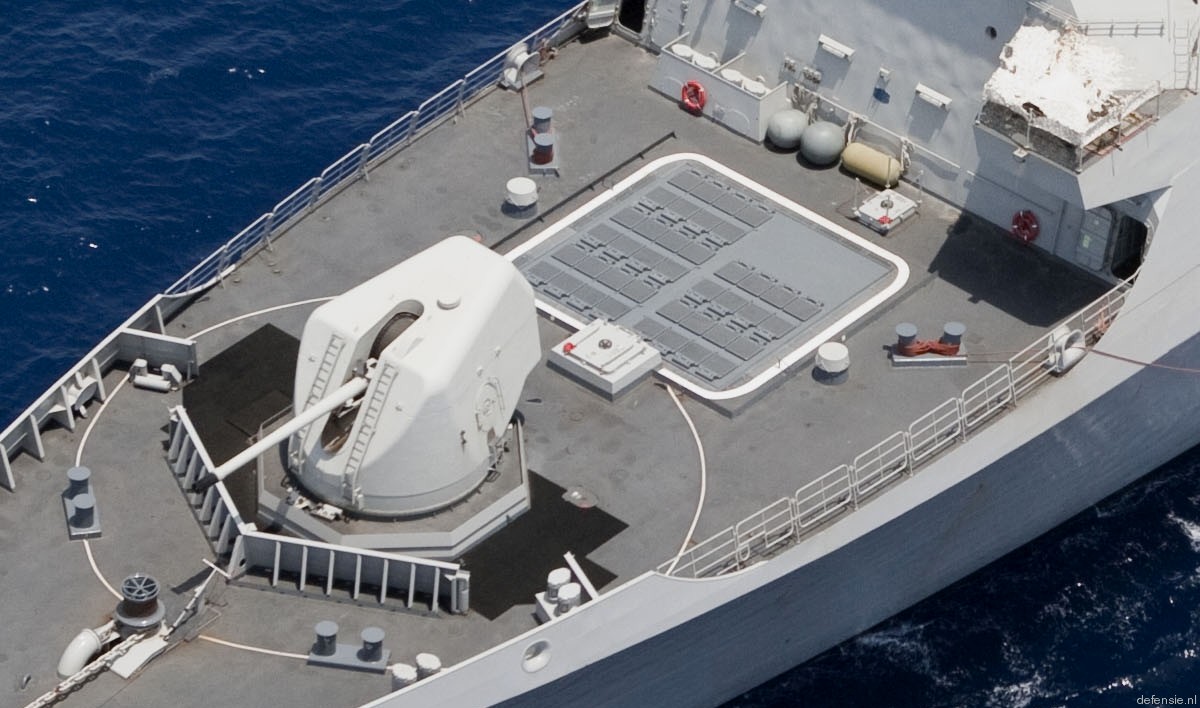
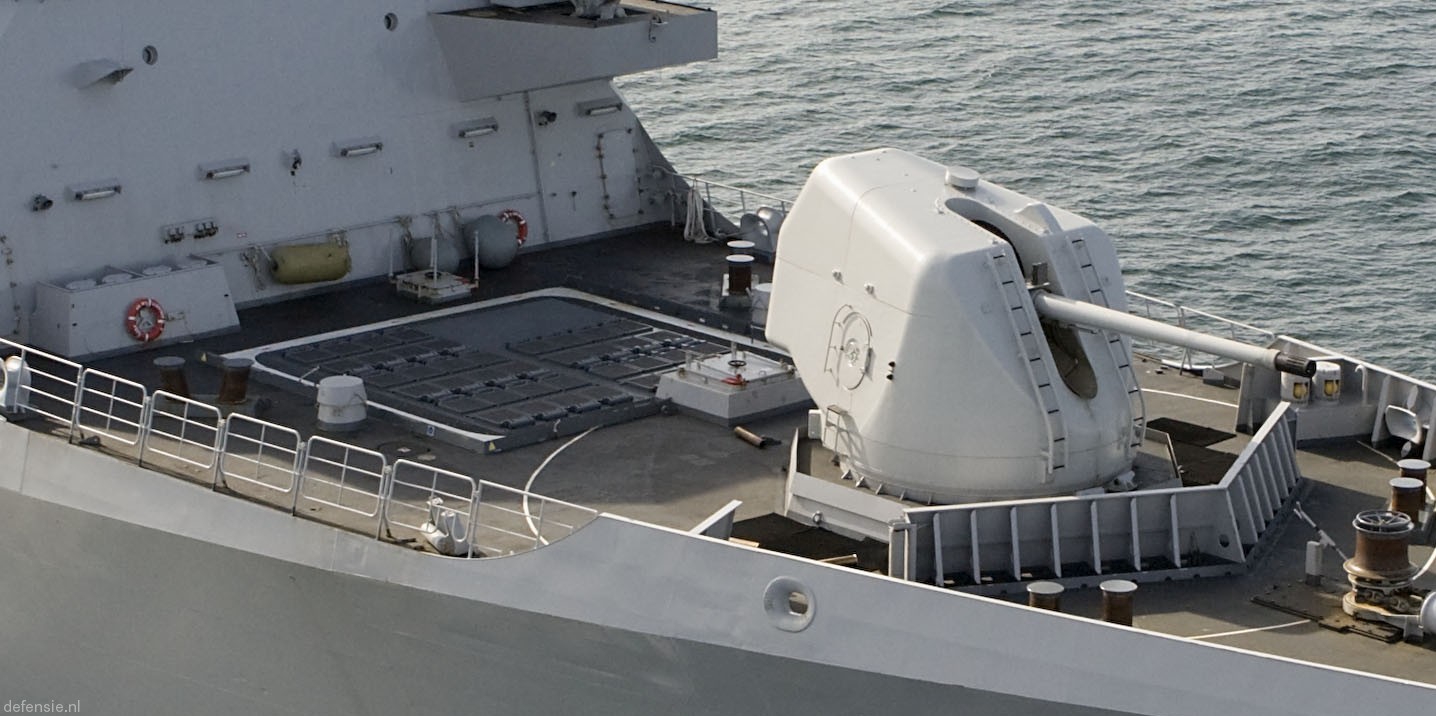
OTO-Breda 127 mm/54 Compact DP
gun:
This is the ship's main gun, a dual-purpose
anti-air/anti-surface gun which fires rounds to a range of
more than 15 kilometers in surface fire mode, and of 7+
kilometers in anti-aircraft fire mode; maximum firing rate
is 45 rounds per minute; can automatically fire 66x rounds,
thanks to three loading drums, each with 22x rounds; an
automatic selection system allows a choice of ammunition
(antiaircraft, surface target, pyrotechnics, chaff); can be
also used for coastal bombardment. The first two guns are
the old guns of the Canadian Iroquois class destroyers,
which have been fully revised by OTOBREDA. The later ships
will receive new guns. This gun has the future potential to
fire the ERGM guided projectile, should this become
available.
ANTI-SUBMARINE WARFARE
(ASW):
The ships will be fitted with the new STM Atlas Electronik
DSQS-24C hull-mounted sonar.
NH-90 Helicopter:
This is the NFH (Nato Frigate Helicopter), as developed by
NH-Industries, which in itself is a consortium formed by
four companies: Augusta, Eurocopter France, Eurocopter
Deutschland, and Fokker. The NH-90 is a twin-engine 6-ton
helicopter with a 3-ton useful load. It has a low radar
signature fuselage, a four-bladed rotor, fly-by-wire
controls, and multiple redundancies for all major systems.
The NH90 will be equipped with sonobuoys or dipping sonar,
tactical radar, a Magnetic Anomaly Detector (MAD), a
tactical Forward Looking Infra-Red (FLIR) system, an
Electronic Warfare System, different anti-submarine weapons,
and a complete set of passive and active protection measures
against the possible threats. It will be capable of night
operations and operations in bad weather.
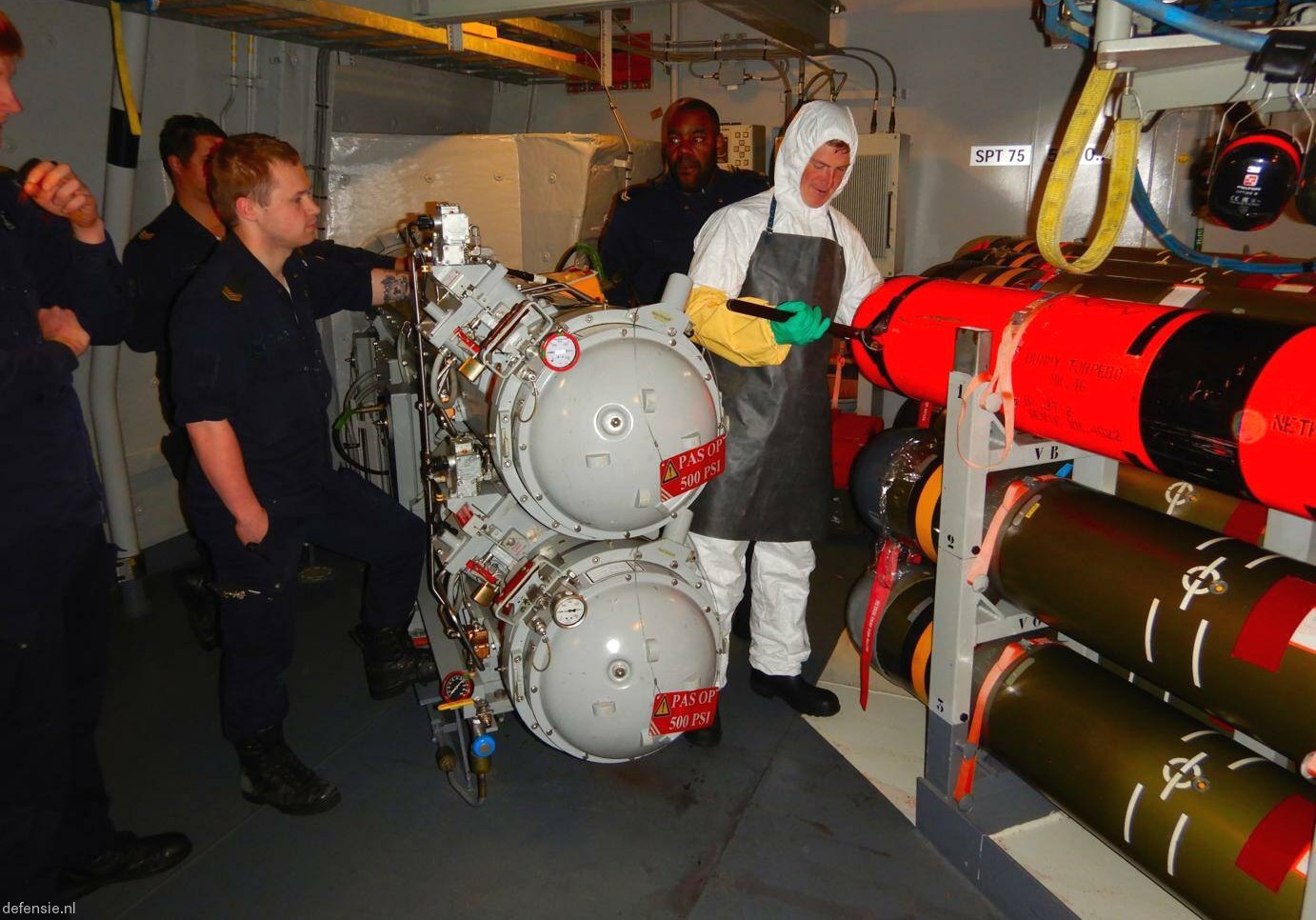
Mk.32 Mod 9 ASW torpedo tubes
(MK-46 torpedoes):
These are fixed torpedo tubes, which will fire the 324mm ASW
MK-46 Mod 5 torpedo. The MK-46 torpedo has a diameter of
324mm, a length of 2.6 meters, and a weight of 232 kg. They
use active/passive acoustic homing, and are designed to
attack the propellers of enemy subs. With a two-speed,
reciprocating external combustion engine they can reportedly
make up to 45 knots, and have a maximum range of more than 8
km.
AN/SLQ-25 NIXIE Torpedo decoy:
This is the Torpedo Countermeasures Transmitting Set
AN/SLQ-25A, better known as 'Nixie'. It is a decoy, which is
towed behind the ship on a Fiber Optic Tow Cable. A signal,
which has been generated inside the ship, is emitted by the
decoy, which 'lures' an acoustic homing torpedo away, by
making it believe that the decoy is the ship it is chasing.
Theoretically the Nixie should be able to be deployed
anywhere between 10 to 25 knots, but practice has shown that
at speeds exceeding 15 knots reeling the decoy in or out
might damage the towing cable.
|
additional information:
Antiaircraft warfare:
These ships were optimized for antiaircraft warfare. For
this role the ships are equipped with an advanced sensor and
weapons suite. The primary sensors for this role are the
long range surveillance radar SMART-L and the multifunction
radar APAR. The SMART-L and APAR are highly complementary,
in the sense that SMART-L is a D band radar providing very
long range surveillance while APAR is an I band radar
providing precise target tracking, a highly capable horizon
search capability, and missile guidance using the
Interrupted Continuous Wave Illumination (ICWI) technique,
thus allowing guidance of 32 semi-active radar homing
missiles in flight simultaneously, including 16 in the
terminal guidance phase. The primary antiaircraft weapons
are the point defence Evolved Sea Sparrow Missile and the
area defence RIM-66 Standard Missile (SM-2) Block IIIA. The
Mk 41 Vertical Launch System is used to house and launch
these missiles. 32 Evolved Sea Sparrow Missile and 32
Standard Missile SM-2 Block IIIA are carried.
Ballistic missile
defence (BMD):
The Navy is investigating the use of these ships for the
role of Ballistic Missile Defence (BMD). During tests
carried out by HNLMS Tromp in the Pacific Ocean near Hawaii,
experimental modifications to the SMART-L to allow even
longer range were proven. A study by the Koninklijke Marine,
the Netherlands Defence Material Organization, Thales
Nederland, Raytheon Missile Systems, Johns Hopkins
University Applied Physics Laboratory, and Lockheed Martin
has been conducted to establish the feasibility of modifying
the De Zeven Provinciën class to provide it the capability
to intercept ballistic missiles. In particular, the study
examined the feasibility of integrating the SM-3 Block IB
missile with the SMART-L and APAR radars. The study
concluded that – with certain modifications to the SMART-L
and APAR, as well as to the ship's Combat Management System
and the missile itself – BMD with the De Zeven Provinciën
class could be achieved. During a 2015 very large NATO
exercise the BMD capabilities were proven, the sensor suite
discovered ballistic targets, and the ship destroyed them
using both its own SAM missiles, as well as using a U.S.
Navy destroyer's missiles, by providing target data and
missile guidance.
A contract was awarded for the radar modification in June
2012, operational tests & life firing show the performance
to exceed expectations.
Modernization:
The De Zeven Provinciën-class ships will get the new SMART-L
Mk2 radar that can detect ballistic missiles at a range of
2,000 km (1,200 mi). The Dutch minister promised also that
the APAR radar will have a bigger range than 400 km (250 mi)
as the Netherlands is the first country to participate as an
active missile shield for NATO.
In late 2011, the Ministry of Defence announced a
modernization program to upgrade the SMART-L early-warning
radar so that De Zeven Provinciën-class frigates can detect
and track ballistic missiles at extended range. In 2018
plans were announced to acquire the BMD-capable SM-3
surface-to-air missiles as the ships are provisioned for an
extra 8-cell vertical launch module, De Zeven
Provinciën-class frigates can pass on the tracking and
detection data to other sea-based or land-defense BMD
assets, including U.S. Navy's warships, that can deal with a
ballistic missile threat. This modernization program is
scheduled for completion by late 2017 for the entire De
Zeven Provinciën class.
On 3 May 2018 the Dutch Secretary of Defence, Barbara
Visser, informed the Dutch national parliament that the
evolved sea sparrow missile (ESSM) aboard the De Zeven
Provinciën-class frigates will be upgraded from block 1 to
block 2. This upgrade will be completed by 2024 and will
allow the frigates to deal with the growing threat of modern
anti-ship missiles. ESSM Block 2 allows the four frigates to
defend against missiles that have greater speed, agility and
perform unexpected movements. The current Harpoon
surface-to-surface missile (SSM) will also be replaced with
a new SSM by 2024. Furthermore, the 127mm-cannon will be
replaced with a new similar cannon. The current cannons are
over 50 years old and originate from Canadian ships. The new
cannon must be able to fire multiple types of ammunition,
including in the future precision-guided ammunition. The
project costs between € 100 million and € 250 million, and
will be take place between 2018 and 2023. Lastly, the
Goalkeepers will be upgraded to a new version and all ships
will have two installed as originally designed, they will
eventually be replaced after 2025 by a new system.
Surface and subsurface
warfare:
As noted above, these ships were optimized for antiaircraft
warfare, but they also have weapons on-board capable of
attacking surface and submarine targets, for example: the
RGM-84F Harpoon missile and Mk. 46 torpedoes. In a new
defense Study published by the Dutch government in March
2018, it was stated the frigates will receive a new
surface-to-surface missile to succeed the Harpoon Block 1D.
Proposals to equip some of the Zeven Provinciën-class
frigates with a total of 32 BGM-109 Tomahawk cruise missiles
have existed, but these were shelved in May 2005.
source: wikipedia |
|