 |
||
|
HOME
|
US Navy -
ships
|
US Navy - air
units
|
USMC - air
units
|
International
Navies
|
Weapon Systems
|
Special Reports |
||
|
US Navy - Aircraft Carrier CVN 78 - USS Gerald R. Ford |
||
|
||
| 01/26 | ||
|
Type, class: Aircraft Carrier, nuclear propulsion -
CVN; Gerald R. Ford class Builder: Huntington Ingalls Industries, Newport News Shipbuilding, Newport News, Virginia, USA STATUS: Awarded: September 10, 2008 Laid down: November 14, 2009 Launched: November 17, 2013 Commissioned: July 22, 2017 IN SERVICE Homeport: Naval Station Norfolk, Virginia Namesake: Gerald R. Ford (1913-2006), 38th President of the USA Ships Motto: INTEGRITY AT THE HELM Technical Data: see: INFO > Gerald R. Ford class Aircraft Carrier - CVN |
||
|
Deployments / Carrier Air Wings embarked / major maintenance periods: July 2018 - October 2018: Post Shakedown Availability (PSA) at Newport News Shipbuilding, Virginia August 2021 - February 2022: Planned Incremental Availability (PIA) at Newport News Shipbuilding, Virginia October 4, 2022 - November 26, 2022 with Carrier Air Wing 8 (CVW-8) - maiden deployment - Atlantic Ocean May 2023 - January 2024 with Carrier Air Wing 8 (CVW-8) - Atlantic Ocean, Mediterranean Sea June 2025 - ? with Carrier Air Wing 8 (CVW-8) - US EUCOM AOR Carrier Air Wing 8 (CVW 8) squadrons 2025: Strike Fighter Squadron 37 / VFA-37 Ragin’ Bulls Strike Fighter Squadron 213 / VFA-213 Blacklions Strike Fighter Squadron 31 / VFA-31 Tomcatters Strike Fighter Squadron 87 / VFA-87 Golden Warriors Electronic Attack Squadron 142 / VAQ-142 Gray Wolves Airborne Command and Control Squadron 124 / VAW-124 Bear Aces Helicopter Sea Combat Squadron 9 / HSC-9 Tridents Helicopter Maritime Strike Squadron 70 / HSM-70 Spartans Fleet Logistics Support Squadron 40 / VRC-40 Rawhides |
||
| images | ||
 port visit in Saint Thomas, US Virgin Islands - December 1, 2025 - December 6, 2025  with CVW-8 embarked - Western Atlantic Ocean - November 13, 2025 leaving the Mediterranean Sea through the Strait of Gibraltar - November 4, 2025 arriving in Split, Croatia - October 21, 2025  with CVW-8 embarked - Strait of Gibraltar - October 1, 2025  with CVW-8 embarked - arriving in Oslo, Norway - September 12, 2025  with CVW-8 embarked - arriving in Oslo, Norway - September 12, 2025  with CVW-8 embarked - North Sea - August 2025  with CVW-8 embarked - North Sea - August 2025  with CVW-8 embarked - North Sea - August 2025  with CVW-8 embarked - Strait of Dover - August 17, 2025  with CVW-8 embarked - Strait of Gibraltar - August 13, 2025  with CVW-8 embarked - Mediterranean Sea - August 2025  with CVW-8 embarked - departing Marseille, France - August 10, 2025  with CVW-8 embarked - Mediterranean Sea - August 2025  with CVW-8 embarked - Mediterranean Sea - August 2025  with CVW-8 embarked - Mediterranean Sea - August 2025  with CVW-8 embarked - NATO Exercise Neptune Strike - Ionian Sea - July 2025  with CVW-8 embarked - NATO Exercise Neptune Strike - Ionian Sea - July 2025  with CVW-8 embarked - NATO Exercise Neptune Strike - Ionian Sea - July 2025  with CVW-8 embarked - NATO Exercise Neptune Strike - Ionian Sea - July 2025  with CVW-8 embarked - NATO Exercise Neptune Strike - Ionian Sea - July 2025  with CVW-8 embarked - Strait of Gibraltar - July 19, 2025  with CVW-8 embarked - Atlantic Ocean - July 2025  ammunition transfer with USS George H. W. Bush (CVN 77) - Atlantic Ocean - June 27, 2025  ammunition transfer with USS George H. W. Bush (CVN 77) - Atlantic Ocean - June 27, 2025 Gerald R. Ford Carrier Strike Group - GRF CSG (Carrier Strike Group Twelve - CSG 12) departs for a scheduled deployment to the US European Command (EUCOM) area of responsibility - June 24, 2025  departing Naval Station Norfolk, Virginia - June 24, 2025  departing Naval Station Norfolk, Virginia - June 24, 2025  with CVW-8 embarked - COMPTUEX - Atlantic Ocean - April 2025  with CVW-8 embarked - COMPTUEX - Atlantic Ocean - April 2025  with CVW-8 embarked - COMPTUEX - Atlantic Ocean - March 2025  Atlantic Ocean - December 2024  with CVW-8 embarked - Atlantic Ocean - November 2024  with CVW-8 embarked - Atlantic Ocean - November 2024  with CVW-8 embarked - Atlantic Ocean - November 2024  Atlantic Ocean - September 2024  with USS Dwight D. Eisenhower (CVN 69) - Atlantic Ocean - August 2024  returning to Naval Station Norfolk, Virginia - January 17, 2024  returning to Naval Station Norfolk, Virginia - January 17, 2024  returning to Naval Station Norfolk, Virginia - January 17, 2024  returning to Naval Station Norfolk, Virginia - January 17, 2024  with CVW-8 embarked - Strait of Gibraltar - January 5, 2024  with CVW-8 embarked - Mediterranean Sea - December 2023  with CVW-8 embarked - Mediterranean Sea - December 2023  with CVW-8 embarked - Naval Support Activity Souda Bay, Crete, Greece - December 2023 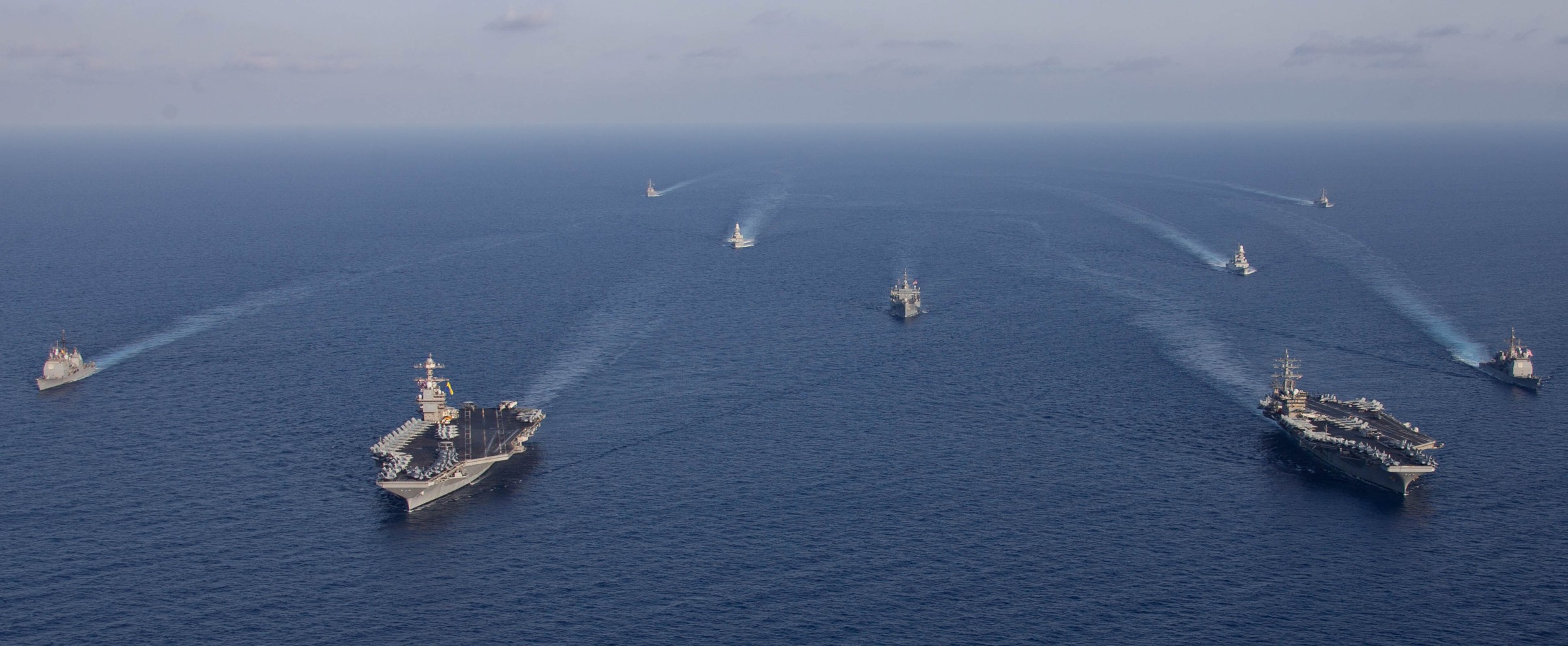 Ships from the Gerald R. Ford and Dwight D. Eisenhower Carrier Strike Groups (CSG), U.S. Sixth Fleet command ship USS Mount Whitney (LCC 20), and Italian Navy frigates Carlo Margottini (F 592) and Virginio Fasan (F 591) sail in formation in the Mediterranean Sea, November 3, 2023. Gerald R. Ford Carrier Strike Group ships: USS Gerald R. Ford (CVN 78), USS Normandy (CG 60), USS Ramage (DDG 61) and USS Paul Ignatius (DDG 117). Dwight D. Eisenhower Carrier Strike Group ships: USS Dwight D. Eisenhower (CVN 69), USS Philippine Sea (CG 58), USS Gravely (DDG 107) and USS Mason (DDG 87) 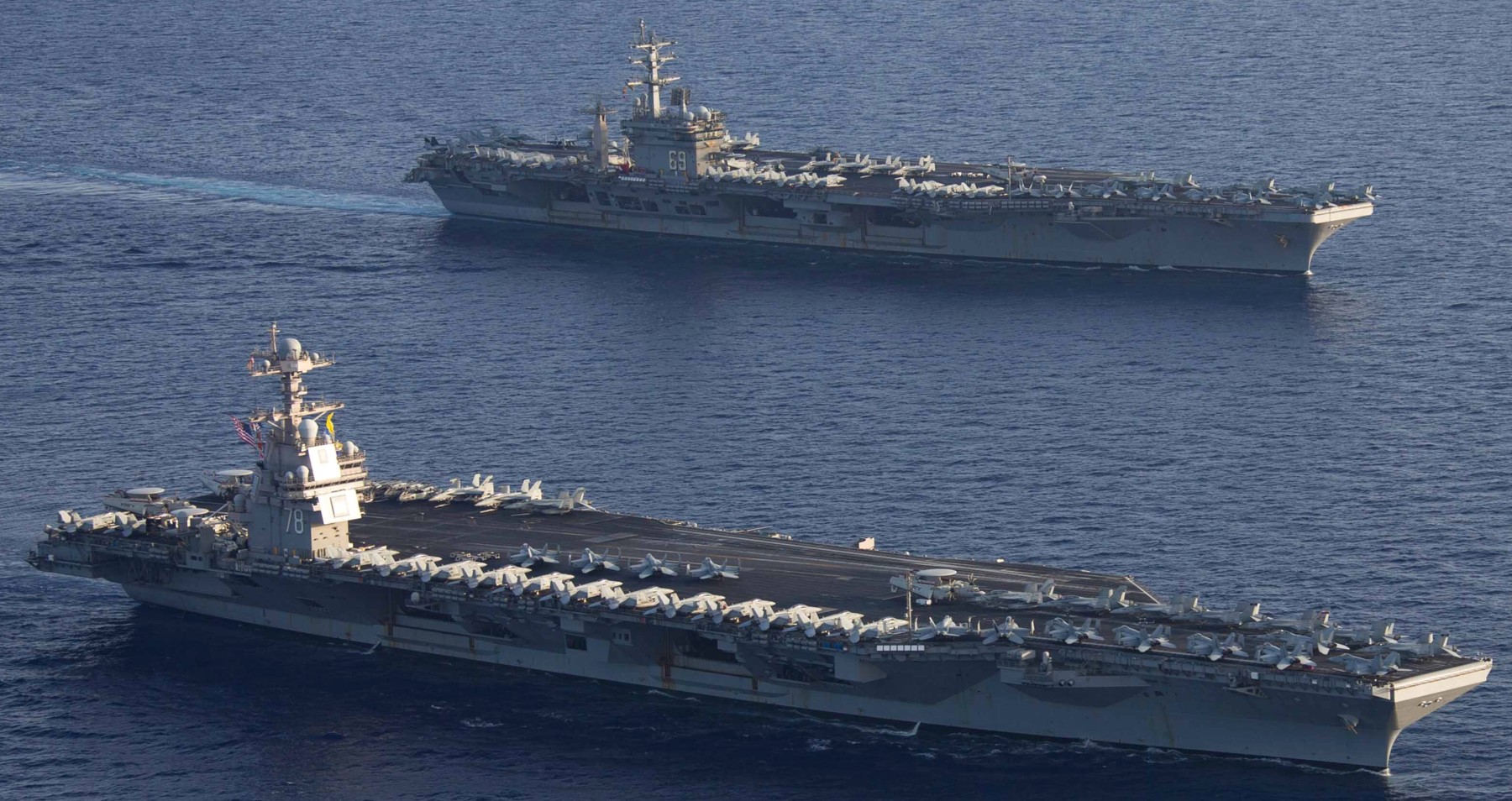 with USS Dwight D. Eisenhower (CVN 69) - Mediterranean Sea - November 3, 2023  with CVW-8 embarked - Mediterranean Sea - November 2023  with CVW-8 embarked - Eastern Mediterranean Sea - October 2023  with CVW-8 embarked - Ionian Sea - October 2023  with CVW-8 embarked - Ionian Sea - October 2023  with CVW-8 embarked - Trieste, Italy - September 2023  with CVW-8 embarked - arriving in Antalya, Turkey - August 25, 2023  with CVW-8 embarked - Mediterranean Sea - August 2023  with CVW-8 embarked - Mediterranean Sea - August 2023  with CVW-8 embarked - Adriatic Sea - July 2023  Split, Croatia - June 2023  with CVW-8 embarked - Adriatic Sea - June 2023  with CVW-8 embarked - Adriatic Sea - June 2023  with CVW-8 embarked - Adriatic Sea - June 2023  with CVW-8 embarked - Strait of Gibraltar - June 2023  with CVW-8 embarked - Strait of Gibraltar - June 2023  with CVW-8 embarked - Norwegian Sea - June 2023  with CVW-8 embarked - Norwegian Sea - June 2023  with CVW-8 embarked - approaching Oslo, Norway - May 23, 2023  with CVW-8 embarked - approaching Oslo, Norway - May 23, 2023  with CVW-8 embarked - approaching Oslo, Norway - May 23, 2023  with CVW-8 embarked - North Sea - May 2023  with CVW-8 embarked - North Sea - May 2023  with CVW-8 embarked - North Sea - May 2023  with CVW-8 embarked - North Sea - May 2023  with CVW-8 embarked - North Sea - May 2023  with CVW-8 embarked - North Sea - May 2023  with CVW-8 embarked - Atlantic Ocean - May 2023  departing Naval Station Norfolk, Virginia - May 2, 2023  departing Naval Station Norfolk, Virginia - May 2, 2023  departing Naval Station Norfolk, Virginia - May 2, 2023  with CVW-8 embarked - Composite Training Unit Exercise (COMPTUEX) - Atlantic Ocean - March 2023  with CVW-8 embarked - Composite Training Unit Exercise (COMPTUEX) - Atlantic Ocean - March 2023  with CVW-8 embarked - Composite Training Unit Exercise (COMPTUEX) - Atlantic Ocean - March 2023  with CVW-8 embarked - Composite Training Unit Exercise (COMPTUEX) - Atlantic Ocean - March 2023  with CVW-8 embarked - Composite Training Unit Exercise (COMPTUEX) - Atlantic Ocean - March 2023  returning to Naval Station Norfolk, Virginia - November 26, 2022  returning to Naval Station Norfolk, Virginia - November 26, 2022  returning to Naval Station Norfolk, Virginia - November 26, 2022  returning to Naval Station Norfolk, Virginia - November 26, 2022  returning to Naval Station Norfolk, Virginia - November 26, 2022  with CVW-8 embarked - exercise Silent Wolverine - Atlantic Ocean - November 2022  with CVW-8 embarked - exercise Silent Wolverine - Atlantic Ocean - November 2022  with CVW-8 embarked - exercise Silent Wolverine - Atlantic Ocean - November 2022  with CVW-8 embarked - exercise Silent Wolverine - Atlantic Ocean - November 2022  ship's first international port visit in Halifax, Nova Scotia, Canada - October 28, 2022  ship's first international port visit in Halifax, Nova Scotia, Canada - October 28, 2022  with CVW-8 embarked - Atlantic Ocean - October 2022  with CVW-8 embarked - Atlantic Ocean - October 2022  with CVW-8 embarked - Atlantic Ocean - October 2022  with CVW-8 embarked - Atlantic Ocean - October 2022  with CVW-8 embarked - Atlantic Ocean - October 2022  with CVW-8 embarked - Atlantic Ocean - October 2022  departing Naval Station Norfolk, Virginia - October 4, 2022  departing Naval Station Norfolk, Virginia - October 4, 2022  carrier qualifications with CVW-8 - Atlantic Ocean - April 2022  carrier qualifications with CVW-8 - Atlantic Ocean - April 2022  carrier qualifications with CVW-8 - Atlantic Ocean - April 2022  carrier qualifications with CVW-8 - Atlantic Ocean - April 2022  carrier qualifications with CVW-8 - Atlantic Ocean - April 2022  carrier qualifications with CVW-8 - Atlantic Ocean - April 2022  carrier qualifications with CVW-8 - Atlantic Ocean - April 2022  carrier qualifications with CVW-8 - Atlantic Ocean - April 2022  carrier qualifications with CVW-8 - Atlantic Ocean - April 2022  carrier qualifications with CVW-8 - Atlantic Ocean - April 2022  with Carrier Air Wing 8 (CVW-8) embarked - Atlantic Ocean - March 2022  with Carrier Air Wing 8 (CVW-8) embarked - Atlantic Ocean - March 2022  Atlantic Ocean - March 2022  Atlantic Ocean - March 2022  Atlantic Ocean - March 2022  Atlantic Ocean - March 2022  Atlantic Ocean - March 2022  Naval Station Norfolk, Virginia - August 2021  shock trials - Atlantic Ocean - June 2021  shock trials - Atlantic Ocean - June 2021  Atlantic Ocean - March 2021  Atlantic Ocean - March 2021  Atlantic Ocean - November 2020  Atlantic Ocean - June 2020  Atlantic Ocean - June 2020  Atlantic Ocean - June 2020  with USS Harry S. Truman (CVN 75) - Atlantic Ocean - June 2020  with USS Harry S. Truman (CVN 75) - Atlantic Ocean - June 2020  with USS Harry S. Truman (CVN 75) - Atlantic Ocean - June 2020  with USS Harry S. Truman (CVN 75) - Atlantic Ocean - June 2020  carrier qualifications - Atlantic Ocean - May 2020  carrier qualifications - Atlantic Ocean - May 2020  Atlantic Ocean - May 2020  flight operations - Atlantic Ocean - April 2020  flight operations - Atlantic Ocean - March 2020  combat direction center (CDC) - Atlantic Ocean - March 2020  Newport News, Virginia - November 2019  exercising high speed turns - Atlantic Ocean - October 2019  exercising high speed turns - Atlantic Ocean - October 2019  exercising high speed turns - Atlantic Ocean - October 2019  Atlantic Ocean - October 2019  Atlantic Ocean - October 2019  Atlantic Ocean - October 2019  October 2019  post shakedown availability at Huntington Ingalls Newport News Shipbuilding - March 2019  post shakedown availability at Huntington Ingalls Newport News Shipbuilding - March 2019  post shakedown availability at Huntington Ingalls Newport News Shipbuilding - March 2019  Huntington Ingalls Newport News Shipbuilding - July 2018  Huntington Ingalls Newport News Shipbuilding - July 2018  Huntington Ingalls Newport News Shipbuilding - July 2018  USS Gerald R. Ford (CVN 78) is pushed by tug boats as the ship enters Huntington Ingalls Newport News Shipbuilding to begin post shakedown availability - July 2018  August 2017  test & evaluation - July 2017 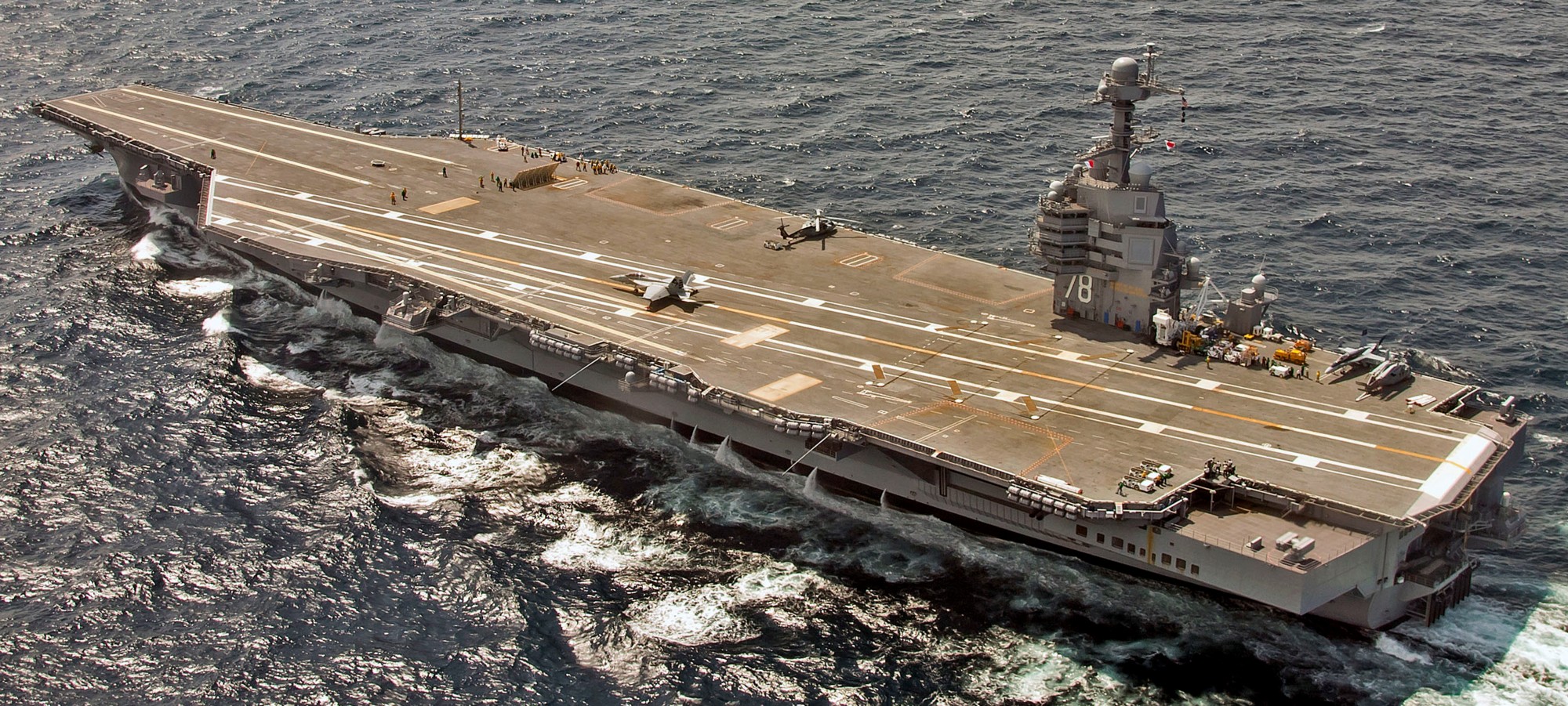 test & evaluation - July 2017  test & evaluation - July 2017 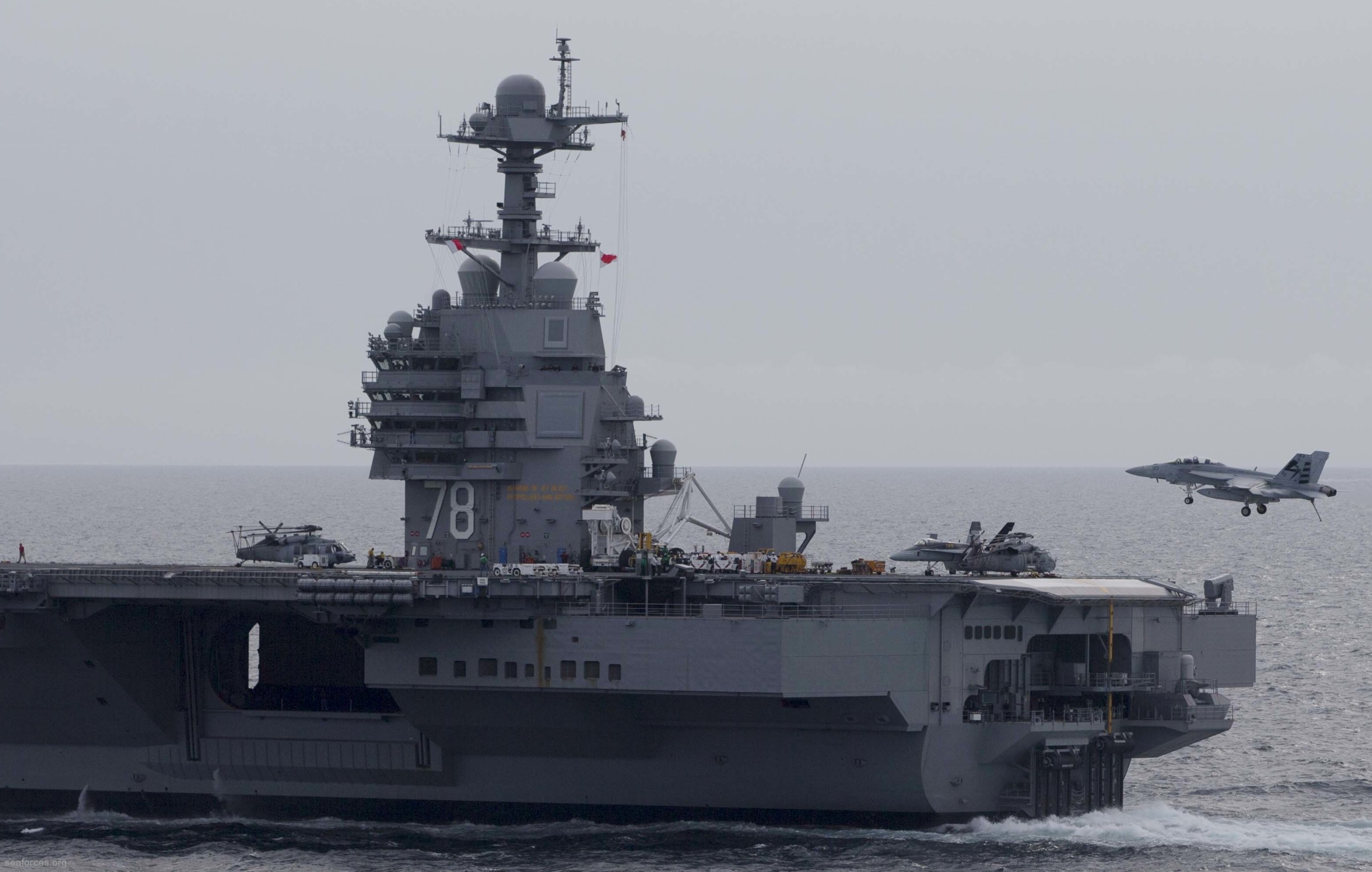 test & evaluation - July 2017  commissioning ceremony - Naval Station Norfolk, Virginia - July 22, 2017  commissioning ceremony - Naval Station Norfolk, Virginia - July 22, 2017 Pre-commissioning Unit / PCU Gerald R. Ford (CVN 78)  Norfolk, Virginia - April 2017  Norfolk, Virginia - April 2017 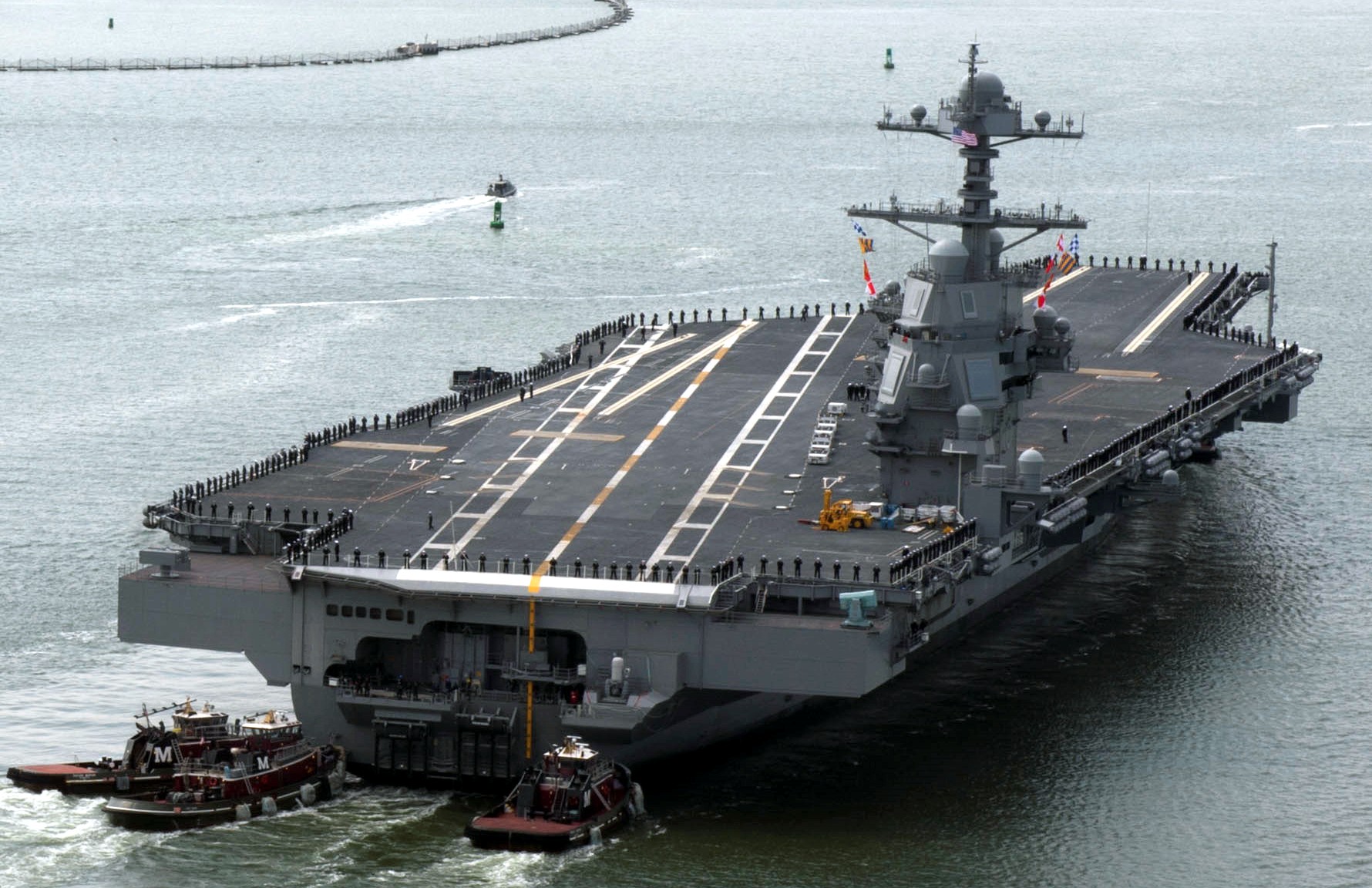 Norfolk, Virginia - April 2017  Newport News, Virginia - April 2017  Newport News, Virginia - April 2017  Newport News, Virginia - April 2017 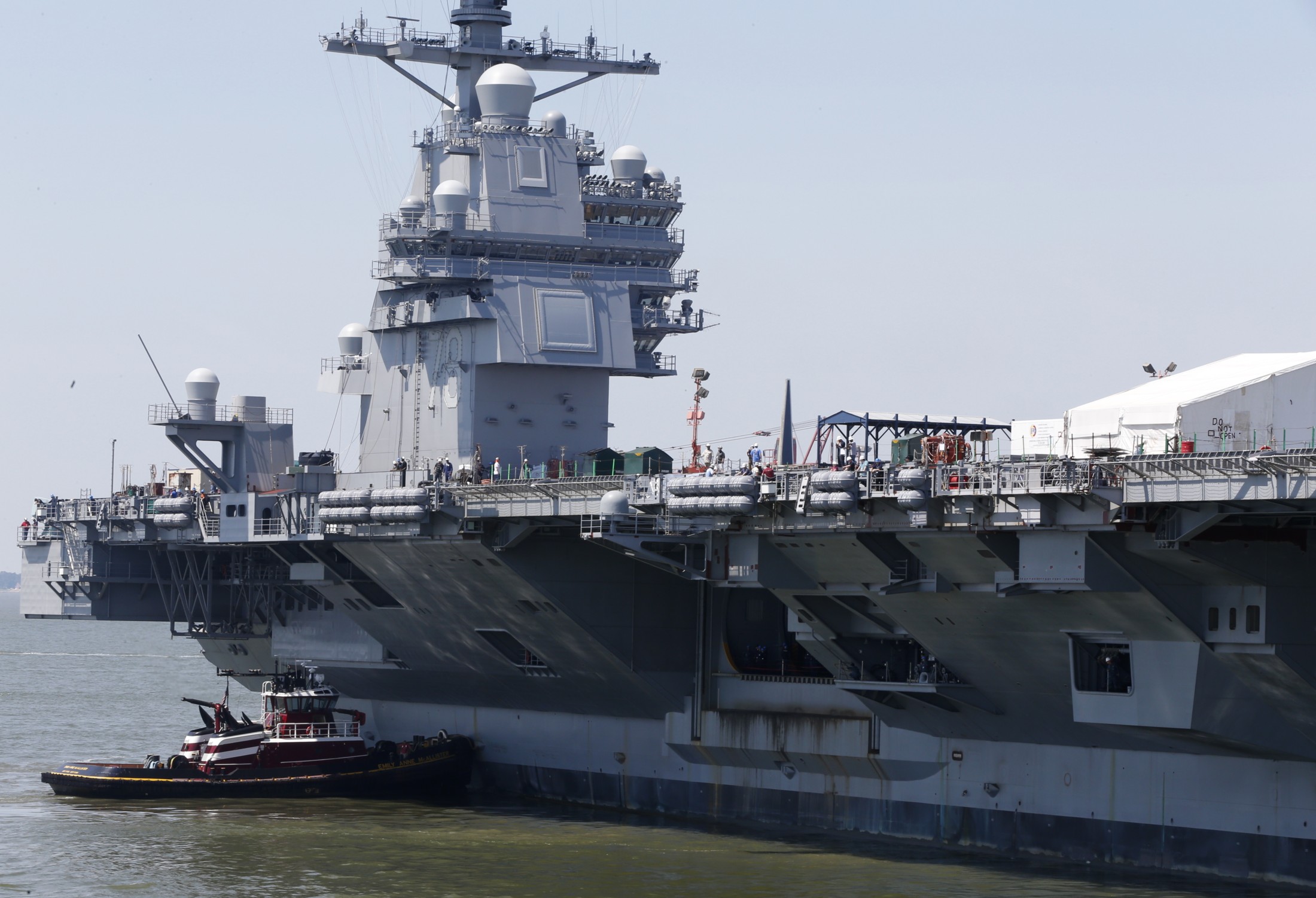 at Huntington Ingalls Newport News Shipbuilding, Virginia - June 2016  at Huntington Ingalls Newport News Shipbuilding, Virginia - June 2016  at Huntington Ingalls Newport News Shipbuilding, Virginia - June 2016  christening ceremony - November 9, 2013  christening ceremony - November 9, 2013  November 2013  Newport News Shipbuilding begins flooding Dry Dock 12 to float the first in class aircraft carrier, PCU Gerald R. Ford (CVN 78) - NEWPORT NEWS, Virginia - October 11, 2013  Newport News Shipbuilding begins flooding Dry Dock 12 to float the first in class aircraft carrier, PCU Gerald R. Ford (CVN 78) - NEWPORT NEWS, Virginia - October 11, 2013  construction at Huntington Ingalls Industries - Newport News Shipbuilding, Virginia - May 2013  construction at Huntington Ingalls Industries - Newport News Shipbuilding, Virginia - May 2013  January 2013  placing the island in position - January 2013  propeller preparations - May 2012  placing the bow section - May 2012  under construction - February 2012  under construction - January 2012  under construction - May 2011  under construction - March 2011 |
||
Gerald R. Ford
 
  Group photo of ships gunnery officers aboard the fast aircraft carrier USS Monterey (CVL 26). Pictured second from right in first row is Lt. Gerald R. Ford Jr., who later became the 38th President of the United States (1974-1977). Ford received his commission as an Ensign in the U.S Naval Reserve on April 13, 1942 and later participated in many actions in the Pacific aboard USS Monterey. He earned the rank of Lieutenant Commander, and was eventually released from active duty under honorable conditions in Feb. 1946. 
 
  President Gerald R. Ford and Soviet General Secretary Leonid Brezhnev  President Gerald R. Ford and Soviet General Secretary Leonid Brezhnev - 1974 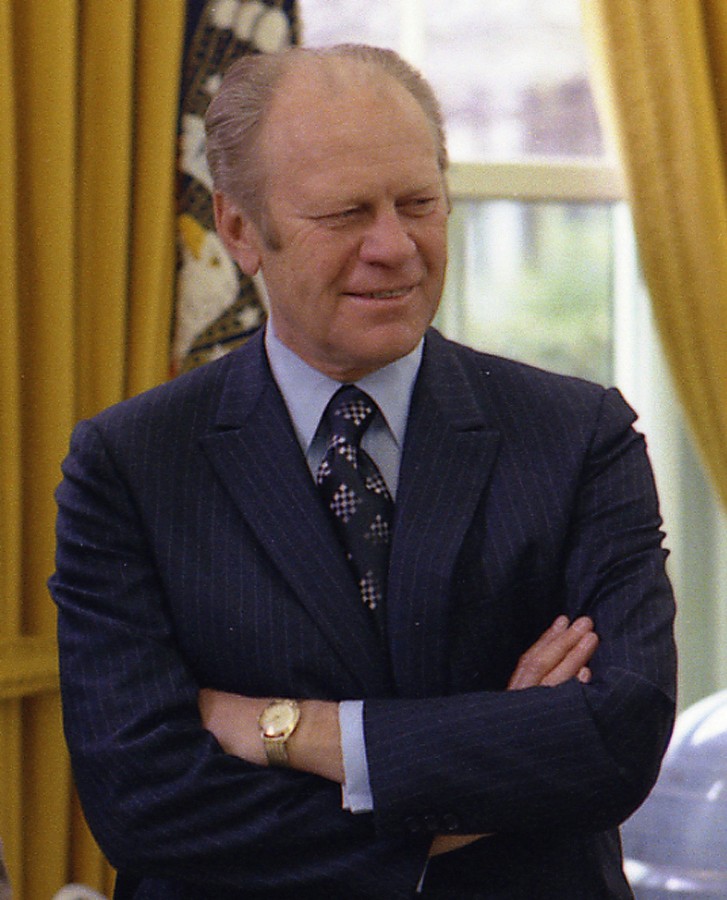
  President Gerald R. Ford with First Lady Elizabeth Anne Ford |
||
|
Gerald Rudolph Ford, jr. (July 14, 1913 - December 26,
2006): Known to his friends as “Jerry,” President Ford was born Leslie King, Jr. on 14 July 1913 in Omaha, Nebraska. After his parents divorced, his mother moved to Grand Rapids, Michigan, and married a prominent business man, Gerald R. Ford, who adopted him and gave him his name. Gerald Ford, Jr. spent his childhood in Grand Rapids and graduated from the former South High School. He later earned a Bachelor of Arts degree in 1935 from the University of Michigan where he was a member of the senior honor society Michigamua. He received his law degree from Yale University Law School in 1941, was admitted to the Michigan State Bar that same year, and was admitted to practice before the United States Supreme Court. In 1965, he was awarded the honorary degree of Doctor of Laws by Michigan State University and Albion, Aquinas and Spring Arbor Colleges; in 1968 by Buena Vista and Grove City Colleges; in 1972 by Belmont Abbey College (North Carolina); in 1973 by Western Michigan University; and in 1975 by Southern Methodist University. He received a Doctor of Public Administration degree from American International College in 1968. President Ford was an accomplished athlete. He won all-city and all-state football honors in Grand Rapids during high school. While earning three varsity letters, he was a member of the University of Michigan’s undefeated national championship teams of 1932 and 1933, and was named Michigan’s most valuable player in 1934, playing center. On New Year’s Day, 1935, he participated in the Shrine East-West Crippled Children’s Benefit Classic in San Francisco. That August he played in the All-Star game against the Bears in Chicago. While a Yale law student, he was assistant varsity football coach. In 1959, he was selected by Sports Illustrated to receive its Silver Anniversary All-American Award as one of the 25 football players in the preceding quarter century who had contributed most to their fellow citizens. In 1972, he was awarded the National Football Foundation’s gold medal for close association with the game. Ford received a commision as ensign in the US Naval Reserve on 13 April 1942 and ultimately served 47 months on active duty during World War II. His background as a coach and trainer made him a good candidate for instructor in the Navy's V-5 (aviation cadet) program. On 20 April, he reported for active duty to the V-5 instructor school at Annapolis, Maryland. After one month of training, he went to Navy Preflight School in Chapel Hill, North Carolina, where he was one of 83 instructors and taught elementary seamanship, ordnance, gunnery, first aid, and military drill. In addition, he coached in all nine sports that were offered, but mostly in swimming, boxing and football. During the one year he was at the Preflight School, he was promoted to Lieutenant Junior Grade on 2 June 1942 and to Lieutenant on 1 March 1943. Applying for sea duty, Ford was sent in May 1943 to the pre-commissioning detachment for a new light aircraft carrier, USS Monterey (CVL-26) at New York Shipbuilding Corporation, Camden, New Jersey. From the ship's commissioning on 17 June 1943 until the end of December 1944, Ford served as the assistant navigator, athletic officer, and anti-aircraft battery officer on board Monterey. While he was on board, Monterey participated in many actions in the Pacific with the Third and Fifth Fleets during the fall of 1943 and in 1944. In 1943, the carrier helped secure Makin Island in the Gilberts, and participated in carrier strikes against Kavieng, New Ireland in 1943. During the spring of 1944, Monterey supported landings at Kwajalein and Eniwetok and participated in carrier strikes in the Marianas, Western Carolines, and northern New Guinea, as well as in the Battle of Philippine Sea. After overhaul, from September to November 1944, aircraft from Monterey launched strikes against Wake Island, participated in strikes in the Philippines and Ryukus, and supported the landings at Leyte and Mindoro. Although the ship was not damaged by the Japanese forces, Monterey was one of several ships damaged by the typhoon, which hit Admiral Halsey's Third Fleet on 18-19 December 1944. The Third Fleet lost three destroyers and over 800 men during the typhoon. Monterey was damaged by a fire which was started by several of the ship's aircarft tearing loose from their cables and colliding during the storm. During the storm, Ford narrowly missed being a casualty himself. As Ford headed for his battle station on the bridge of the ship in the early morning of 18 December, the ship rolled twenty-five degrees which caused Ford to lose his footing and slide toward the edge of the deck. The two inch steel ridge around the edge of the carrier slowed him enough so he could roll and twist into the catwalk below the deck. As he later stated, "I was lucky; I could have easily gone overboard." After the fire, Monterey was declared unfit for service and the crippled carrier reached Ulithi on 21 December before preceding across the Pacific to Bremerton, Washington, where it underwent repairs. On Christmas Eve 1944 at Ulithi, Ford was detached from the ship and sent to the Navy Pre-Flight School, St. Mary's College, California, where he was assigned to the Athletic Department until April 1945. One of his duties was to coach football. From the end of April 1945 to January 1946, he was on the staff of the Naval Reserve Training Command, Naval Air Station, Glenview, Illinois, as the Staff Physical and Military Training Officer. On 3 October 1945, he was promoted to Lieutenant Commander. In January 1946, he was sent to the Separation Center, Great Lakes, Illinois, to be outprocessed. He was released from active duty under honorable conditions on 23 February 1946. On 28 June 1963, the Secretary of the Navy accepted Ford's resignation from the Naval Reserve. Returning to Grand Rapids after the war, Ford resumed law practice. In 1948, he received the Grand Rapids JayCees Distinguished Service Award for work in various community projects. The following year he was named one of “America’s Ten Outstanding Young Men” by the US Junior Chamber of Commerce and received its Distinguished Service Award. On 15 October 1948, he married Elizabeth Bloomer of Grand Rapids. The Fords had four children: Michael Gerald (born 15 March 1950); John Gardner (16 March 1952); Steven Meigs (19 May 1956); and Susan Elizabeth (6 July 1957). President Ford was a member of Grace Episcopal Church, Grand Rapids. He maintained active membership in the American Legion, Veterans of Foreign Wars and AMVETS, and was a 33rd Degree Mason. Congressional Service During his first term, Congressman Ford was named to the House Public Works Committee. In 1951 he was assigned to the Appropriations Committee where he served on the Army Civil Functions Subcommittee and the Emergency Agency Subcommittee. During the 83rd and 84th Congresses, he was a member of the Subcommittees on Foreign Operations and the Department of Defense and was on the Army Panel serving as Panel chairman in the 83rd Congress. During the 85th Congress, he was appointed to the Select Committee on Astronautics and Space Exploration. Congressman Ford remained a member of both the Defense and Foreign Operations Subcommittees of the House Appropriations Committee throughout the 85th, 86th, 87th and 88th Congresses. He was senior Republican on the Defense Subcommittee before becoming Minority Leader. Congressman Ford served as a member of the Republican Leadership in Congress beginning in January 1963; was chairman of the Republican Conference of the House during the 88th Congress (1963-64) and had been a member of the House Republican Policy Committee for over nine years. On 4 January 1965 he was chosen Minority Leader of the House of Representatives at the opening of the 89th Congress. In November 1972 he was re-elected to his thirteenth consecutive term as a member of Congress, having served since 3 January 1949, but he resigned 6 December 1973 to become Vice President. He maintained an attendance record of over 90 percent throughout his 24-year tenure. Vice Presidency (6 December 1973 - 9 August 1974) Congressman Ford was nominated on 12 October 1973 to succeed Spiro T. Agnew as Vice President. His nomination was confirmed by the Senate on 27 November 1973 by a vote of 92 to 3 and by the House on 6 December 1973, by a vote of 387 to 35. He was sworn in as Vice President on 6 December 1973, the first person to be so selected according to provisions of the 25th Amendment to the Constitution. Presidency (9 August 1974 - 20 January 1977) When he entered the White House in 1974, Gerald Rudolph Ford, Jr. became the fourth consecutive President to have served in the US Navy. He was the first vice president in American history to succeed to the nation's highest office because of the resignation of a president, and he was the first person to occupy the White House without being elected either president or vice president. President Ford's administration is notable for many events, the most controversial probably being the pardon of former President Richard M. Nixon. On 8 September 1974, only a month after being sworn in, President Ford signed Proclamation 4311 which granted "a full, free, and absolute pardon unto Richard Nixon for all offenses against the United States which he...committed or may have committed or taken part in during the period from January 20, 1969 through August 9, 1974." The pardon, which angered many Americans, ultimately contributed to national healing and reconciliation. President Ford subsequently announced an amnesty program for draft dodgers and deserters of the Vietnam War era. About one fifth of the approximately 106,000 men eligible applied for amnesty under the program. The year 1975 brought new challenges to Ford's presidency. In April 1975, the Vietnam War ended when the Republic of (South) Vietnam was conquered by the communist Democratic Republic of (North) Vietnam. President Ford requested from Congress $700 million in emergency military aid for South Vietnam, but when his request was rejected he arranged for American assistance in evacuating American allies and other refugees from that country. Nearly 100,000 refugees subsequently settled in the United States. In May 1975, an international incident occurred when the US merchant ship Mayagüez was seized by Cambodian communist Khmer Rouge forces in the Gulf of Thailand. President Ford chose to respond aggressively to this communist challenge and 200 US Marines were landed on the island of Koh Tang. After bloody fighting on the island between the Khmer Rouge and US Marines, all 39 crew members of Mayagüez were released. President Ford survived two separate assassination attempts in California in September of 1975. In the 1976 election, President Ford narrowly won the Republican presidential nomination, having been challenged by former Governor Ronald Reagan of California. His Democratic opponent was former Governor Jimmy Carter of Georgia. For only the second time in US history, a series of debates between the presidential candidates was televised nationally. Ultimately, Jimmy Carter defeated President Ford by 1.7 million votes and a narrow margin in the electoral college. Living in Rancho Mirage, California, President Ford remained physically and socially active after leaving the White House. He published his autobiography, A Time to Heal, in 1979. The Gerald R. Ford Presidential Library and Museum is located in Ann Arbor, Michigan. President Ford died at his home on 26 December 2006. Notable honors - In November 1963 was named by President Lyndon Johnson to the Warren Commission. - Author (with John R. Stiles) of the book, Portrait of the Assassin (1965). - Served as permanent chairman of the 1968 and 1972 Republican National Conventions. - As Minority House Leader delivered some 200 speeches annually throughout the country. - Visited the People’s Republic of China in late June and early July 1972 on behalf of the President. - Lauded as a “Congressman’s Congressman” by the American Political Science Association when it conferred on him its Distinguished Congressional Service Award in 1961. - Was presented the George Washington Award by the American Good Government Society in May 1966. - Chosen by the American Academy of Achievement to receive the Golden Plate Award as one of fifty “giants of accomplishment,” presented during the Academy’s 10th annual Salute to Excellence in June 1971. - Selected to receive the AMVETS Silver Helmet Award, that group’s highest recognition of Congressional service, at ceremonies in Washington in April 1971. Service Record 13 April 1942: Commissioned Ensign, US Naval Reserves 20 April 1942 - May 1942: Under instruction, US Naval Academy May 1942 - May 1943: US Navy Pre-Flight School, Chapel Hill, North Carolina May 1943 - June 1943: Outfitting and commissioning of USS Monterey (CVL-26) , New York Shipbuilding Corporation, Camden, New Jersey June 1943 - December 1944: Assistant Navigator on USS Monterey (CVL-26) December 1944 - April 1945: Athletic Department of Navy Pre-Flight School, St. Mary's College, California April 1945 - January 1946: Staff Physical and Military Training Officer, Naval Reserve Training Command, Naval Air Station, Glenview, Illinois January 1946 - February 1946: Separated at Great Lakes Naval Training Center, Great Lakes, Illinois 23 February 1946: Date of release from the US Navy 28 June 1963: Resigned Medals and Awards For his naval service in nine combat operations, Lieutenant Commander Ford earned the Asiatic-Pacific Campaign Medal with eight battle stars for actions in the Gilbert Islands, Bismarck Archipelago, Marshall Islands, Asiatic and Pacific carrier raids, Hollandia, Marianas, Western Carolines, Western New Guinea, and the Leyte Operation. He also received the Philippine Liberation with two bronze stars for Leyte and Mindoro, as well as the American Campaign and World War II Victory Medals. (source: US Naval Historical Center) |
||
|
USS Gerald R. Ford (CVN 78): Gerald R. Ford (CVN-78) is the lead ship of her class of United States Navy new supercarriers. It is currently a pre-commissioning unit (PCU) expected to be commissioned into the Navy in 2017. The ship is named after the 38th President of the United States Gerald R. Ford, whose World War II naval service included combat duty aboard the light aircraft carrier Monterey in the Pacific Theater. The keel of Gerald R. Ford was laid down on 13 November 2009. Construction began on 11 August 2005, when Northrop Grumman held a ceremonial steel cut for a 15-ton plate that forms part of a side shell unit of the carrier. She was christened on 9 November 2013. The schedule called for the ship to join the U.S. Navy's fleet in March 2016 with the first deployment in 2019. Gerald R. Ford will enter the fleet replacing the inactive USS Enterprise (CVN-65), which ended her 51 years of active service in December 2012. Construction: On 10 September 2008, the U.S. Navy signed a $5.1 billion contract with Northrop Grumman Shipbuilding in Newport News, Virginia, to design and construct the carrier. Northrop had begun advance construction of the carrier under a $2.7?billion contract in 2005. The carrier is being constructed at the Huntington Ingalls (formerly Northrop Grumman) Newport News Shipbuilding facilities in Newport News, Virginia, which employs 19,000 workers. The keel of the new warship was ceremonially laid on 14 November 2009 in Dry Dock 12 by Ford's daughter, Susan Ford Bales. In a speech to the assembled shipworkers and DoD officials, Bales said: "Dad met the staggering challenges of restoring trust in the presidency and healing the nation's wounds after Watergate in the only way he knew how - with complete honesty and integrity. And that is the legacy we remember this morning." As of August 2011, the carrier was reported to be "structurally halfway complete". In April 2012, it was said to be 75 percent complete. On 24 May 2012, the important milestone of completing the vessel up to the waterline was reached when the critical lower bow was lifted into place. This was the 390th of the nearly 500 lifts of the integral modular components (from which the vessel is assembled) that the ship's construction will ultimately require. On 8 October 2012, the carrier reached over 88 percent of the complete structural construction. Huntington Ingalls reported (in an 8 Nov. 2012 GLOBE NEWSWIRE press release) that they have "Reached 87 percent structural completion of CVN-78 Gerald R. Ford". By 19 December 2012, construction had reached 90 percent structural completion. "Of the nearly 500 total structural lifts needed to complete the ship, 446 have been accomplished." The island was originally scheduled to land in 2012. However, the island landing and ceremony actually took place on 26 January 2013. On 9 April 2013, the flight deck of the carrier was completed following the addition of the ship's upper bow section, bringing the ship to 96 percent structural completion. On 7 May 2013, the last of 162 superlifts was put in place, bringing the ship to 100 percent structural completion. Remaining work that needed to be done included hull painting, shafting work, completion of electrical systems, mooring equipment, installation of radar arrays, and flooding of the dry dock. On 11 July 2013, a time capsule was welded into a small room just above the floor, continuing a long Navy tradition. The time capsule holds items chosen by President Ford's daughter, Susan Ford Bales, and includes sandstone from the White House, Navy coins, and aviator wings from its first commanding officer. The ship was originally scheduled for launch in July 2013 and delivery in 2015. Production delays meant that the launch had to be delayed until 11 October 2013 and the naming ceremony until 9 November 2013, with delivery February 2016. On 3 October 2013, Gerald R. Ford had four 30-ton, 21 ft (6.4 m)-diameter bronze propellers installed. The installation of the propellers required more than 10 months of work to install the underwater shafting. On 11 October 2013, the ship's drydock was flooded for the first time in order to test various seawater-based systems. Her launch date was set to be on the same day as her naming ceremony on 9 November 2013. On 9 November 2013, the ship was christened by Ford's daughter, Susan Ford Bales, with a bottle of American sparkling wine. As of 2013, construction costs were estimated at $12.8 billion, 22% over the 2008 budget, plus $4.7 billion in research and development costs. Because of budget difficulties, the Chief of Naval Operations, Admiral Jonathan Greenert, has warned there may be a two-year delay beyond 2016 in completing Gerald R. Ford. The GAO reports that the price cap will be met by the Navy accepting an incomplete ship for that cost. On 23 September 2015, the Navy announced that several weeks of testing delays will likely slip the delivery date into April or May 2016. In addition, construction was 93% complete as of September 2015. In July 2016, a memo was obtained by CNN from Michael Gilmore, the US Department of Defense's Director of Operational Testing and Evaluation indicating that problems with four major flight systems would further delay combat readiness of the ship. The ship was not expected to be delivered until November 2016 and these issues were suggested to further delay that goal. Construction of the ship was described as 98% complete, with 88% of testing finished. By March 2018, due to issues with the nuclear propulsion system and munitions elevators, construction costs had reached $13.027 billion, making the Gerald R. Ford the most expensive warship ever built. Planned delivery to the Navy has been delayed by three months, to October 2019. Newport News Shipbuilding has released a video documentary on the construction of Gerald R. Ford. Performance improvements: Gerald R. Ford is intended to be the first of a class of aircraft carriers that offer significant performance improvements over the previous Nimitz class. Gerald R. Ford is equipped with an AN/SPY-3 and AN/SPY-4 active electronically scanned array multi-function, multi-band radar, and an island that is shorter in length and 20 feet (6.1 m) taller than that of the Nimitz class; it is set 140 feet (43 m) farther aft and 3 feet (0.91 m) closer to the edge of the ship. Replacing traditional steam catapults, the Electromagnetic Aircraft Launch System (EMALS) will launch all carrier aircraft. This innovation eliminates the traditional requirement to generate and store steam, freeing up considerable area below-deck. With the EMALS, Gerald R. Ford can accomplish 25% more aircraft launches per day than the Nimitz class and requires 25% fewer crew members. The Navy estimates it will save $4 billion in operating costs over a 50-year lifespan. According to an Associated Press story: 'She is truly a technological marvel,' Chief of Naval Operations Adm. Jonathan Greenert said in a webcast ceremony at the Newport News, Va., shipyard where Gerald R. Ford is being built, 'She will carry unmanned aircraft, joint strike fighters, and she will deploy lasers.' These performance enhancements were problematic in Pentagon tests, but final software fixes for some of the problems were delayed until after the ship's post-shakedown availability in 2019. Operational and major system testing: In January 2014, the annual Director, Operational Test and Evaluation (DOT&E) report recorded that critical ship systems in lab and test environments (including the EMALS, Advanced Arresting Gear (AAG), Dual Band Radar, and weapons elevators) were not reliable enough and needed more testing and improvements. The Navy implemented a rigorous testing program to ensure performance issues would be resolved before the systems were installed on the aircraft carrier. Major problems with the main turbine generators were found in June 2016. The fix, requiring design changes, was installed and was verified during acceptance trials in May 2017. The Initial Operational Test & Evaluation milestone was achieved in April 2017. On 8 April 2017, Gerald R. Ford got underway under her own power for the first time as she headed to sea for builder's trials. She completed the trials and returned to port at Naval Station Norfolk on 14 April 2017. On 24 May 2017, she departed for acceptance trials and completed them on 26 May 2017. In 2018, the Navy requested to delay shock trials for at least six years in order to speed up the ship's deployment, but this request was denied. On 18 June 2021, Gerald R. Ford completed her first Full Ship Shock Trial 87 nautical miles (100 mi) off Ponce Inlet, Florida to ensure that she is able to withstand battle conditions. 40,000 lbs. (18 tonnes) of TNT was detonated underwater, measured as a 3.9 magnitude earthquake by USGS. Additional tests were conducted in July and August, with the test detonations set off closer to the hull. The ship was determined to have passed the tests and this concluded the trials. Delivery: On 31 May 2017, Newport News Shipbuilding delivered Gerald R. Ford to the U.S. Navy and her status was changed to Special, in service. Gerald R. Ford was formally commissioned into the United States Navy on 22 July 2017. On 28 July 2017, Lt. Cmdr. Jamie "Coach" Struck of Air Test and Evaluation Squadron 23 (VX-23) performed the first arrested landing and catapult launch from Gerald R. Ford in an F/A-18F Super Hornet. According to a GAO report in mid-2020 the Gerald R. Ford was still reporting significant problems with the operation of its weapons elevators, while a DoD report in early 2021 stated that the ship was still not combat-ready, citing continuing problems with the Electromagnetic Aircraft Launch System (EMALS). Designed to achieve 4,166 aircraft launches between operational mission failures, instead it went 181 launches between failures, "well below the requirement". On 20 March 2021, Gerald R. Ford and Italian aircraft carrier Cavour conducted Ready for Operations (RFO) by the Italian Navy while transiting the Atlantic Ocean. In September 2022, Rear Adm. James Downey described the ship as "fully delivered" and has "met her initial operating capability". Operational service: USS Gerald R. Ford left Naval Station Norfolk for her maiden deployment on 4 October 2022. The carrier was to conduct operations and training exercises alongside NATO allies and partners throughout the Atlantic Ocean. Ford's Carrier Strike Group 12 included Carrier Air Wing 8, USS Normandy, Destroyer Squadron 2 with USS Ramage, USS McFaul and USS Thomas Hudner, auxiliaries USNS Joshua Humphreys and USNS Robert E. Peary, and the United States Coast Guard cutter USCGC Hamilton. Among the first NATO ships assigned to CSG-12 was the German frigate Hessen. Gerald R. Ford's first port visit outside of her home country was on 28 October 2022, to Halifax Harbour in Nova Scotia, home of CFB Halifax, Canada's largest military installation and home port of the Royal Canadian Navy's Atlantic fleet. source: wikipedia |
||
| patches + more | ||
   |
||
| | seaforces.org | USN ships start page | |