 |
||
|
HOME
|
US Navy -
ships
|
US Navy - air
units
|
USMC - air
units
|
International
Navies
|
Weapon Systems
|
Special Reports |
||
|
US Navy - Guided Missile Cruiser CG 72 - USS Vella Gulf |
||
|
||
| 09/24 | ||
|
Type,
class: Guided Missile Cruiser (CG); Ticonderoga
class Builder: Ingalls Shipbuilding, Pascagoula, Mississippi, USA STATUS: Awarded: February 25, 1988 Laid down: April 22, 1991 Launched: June 13, 1992 Commissioned: September 18, 1993 Decommissioned: August 4, 2022 Fate: laid up at Naval Inactive Ship Maintenance Facility (NISMF) Philadelphia, Pennsylvania Namesake: The Battle of Vella Gulf, Southern Pacific (World War II - August 1943) Ships Motto: MOVE SWIFTLY - STRIKE VIGOROUSLY Technical Data: see: INFO > Ticonderoga class Guided Missile Cruiser - CG |
||
| images | ||
 decommissioning ceremony - Naval Station Norfolk, Virginia - August 4, 2022  decommissioning ceremony - Naval Station Norfolk, Virginia - August 4, 2022  Sailors and former shipmates stand in formation during the decommissioning ceremony - Naval Station Norfolk, Virginia - August 4, 2022  returning to Naval Station Norfolk, Virginia - July 2021  returning to Naval Station Norfolk, Virginia - July 2021  returning to Naval Station Norfolk, Virginia - July 2021  returning to Naval Station Norfolk, Virginia - July 2021  returning to Naval Station Norfolk, Virginia - July 2021  Red Sea - June 2021  Mk.45 gun fire exercise - Arabian Sea - June 2021  Mk.15 Phalanx CIWS fire exercise - Arabian Sea - June 2021  January 2021  returning to Naval Station Norfolk, Virginia - August 2020  Gulf of Aden - April 2020  Gulf of Aden - April 2020  Gulf of Aden - April 2020  Strait of Hormuz - April 2020  Atlantic Ocean - February 2020  Atlantic Ocean - February 2020  Atlantic Ocean - February 2020  Atlantic Ocean - February 2020  Yorktown, Virginia - September 2019  Atlantic Ocean - September 2019  Atlantic Ocean - September 2019  Atlantic Ocean - September 2019  Atlantic Ocean - September 2019  Atlantic Ocean - September 2019  Mk.45 gun live fire exercise - Atlantic Ocean - September 2019  departing Naval Station Norfolk, Virginia to avoid Hurricane Dorian - September 2019  Mk.45 gun maintenance - Atlantic Ocean - June 2019  aft Mk.41 Vertical Launching System (VLS) and Mk-45 gun - Atlantic Ocean - December 2018  forward Mk.45 gun fire exercise - Atlantic Ocean - December 2018  departing Naval Station Norfolk, Virginia in preparation to Hurricane Florence - September 2018  departing Naval Station Norfolk, Virginia in preparation to Hurricane Florence - September 2018  returning to Naval Station Norfolk, Virginia - December 2017  Arabian Gulf - October 2017  Arabian Gulf - October 2017  Arabian Gulf - July 2017  Arabian Gulf - June 2017  inflight refueling with a MH-60S Seahawk - Atlantic Ocean - February 2017  April 2016  in dry dock - June 2015  returning to Norfolk, Virginia - September 2014  returning to Norfolk, Virginia - September 2014  Marmara Sea - August 2014  Black Sea - August 2014  Batumi, Georgia - August 2014  helm - Bosporus Straits - August 2014  Black Sea - July 2014  Mk-15 close-in weapon system (CIWS) fire exercise - Mediterranean Sea - June 2014  Mk-45 gun fire exercise - Mediterranean Sea - June 2014  combat information center (CIC) - Mediterranean Sea - June 2014  gas turbine control station - May 2014  aft Mk-41 VLS - Mk-46 gun and Mk-141 RGM-84 Harpoon SSM missile launcher - Mediterranean Sea - May 2014  Mk-15 close-in weapon system (CIWS) fire exercise - Mediterranean Sea - May 2014  Mk-38 Mod.2 machine gun system (MGS) fire exercise - Mediterranean Sea - May 2014  Augusta Bay, Sicily, Italy - April 2014  during exercise Joint Warrior 14-2 - Faslane, Scotland - March 2014  Atlantic Ocean - March 2014  departing Naval Station Norfolk, Virginia for exercise Joint Warrior 14-2 - March 2014  departing Naval Station Norfolk, Virginia for exercise Joint Warrior 14-2 - March 2014  returning to Naval Station Norfolk after a 7-month deployment - August 2012  Souda Bay, Crete, Greece - July 2012  Souda Bay, Crete, Greece - July 2012  Souda Bay, Crete, Greece - July 2012  Souda Bay, Crete, Greece - March 2012  Souda Bay, Crete, Greece - March 2012  returning to Naval Station Norfolk after a 6-month deployment - January 2011  Souda Bay, Crete, Greece - October 2010  Souda Bay, Crete, Greece - October 2010  departing Naval Station Norfolk, Virginia - July 2010  Fleet Week New York - May 2009  returning to Naval Station Norfolk, Virginia after a 7-month deployment - March 2009  Haifa, Israel - March 2009  Haifa, Israel - March 2009  Danish HDMS Absalon (L 16), USS Vella Gulf (CG 72) and USS Mahan (DDG 72) transit the Gulf of Aden - February 2009  port visit - Seychelles - December 2008  Indian Ocean - December 2008  Indian Ocean - December 2008  Indian Ocean - December 2008  Mk-38 Mod.2 machine gun system (MGS) fire exercise - Mediterranean Sea - September 2008  Atlantic Ocean - September 2008  Atlantic Ocean - September 2008  Atlantic Ocean - September 2008  Atlantic Ocean - September 2008  Atlantic Ocean - September 2008  departing Naval Station Norfolk, Virginia - August 2008  forward Mk-45 Mod.2 5-inch gun fire - Atlantic Ocean - July 2008 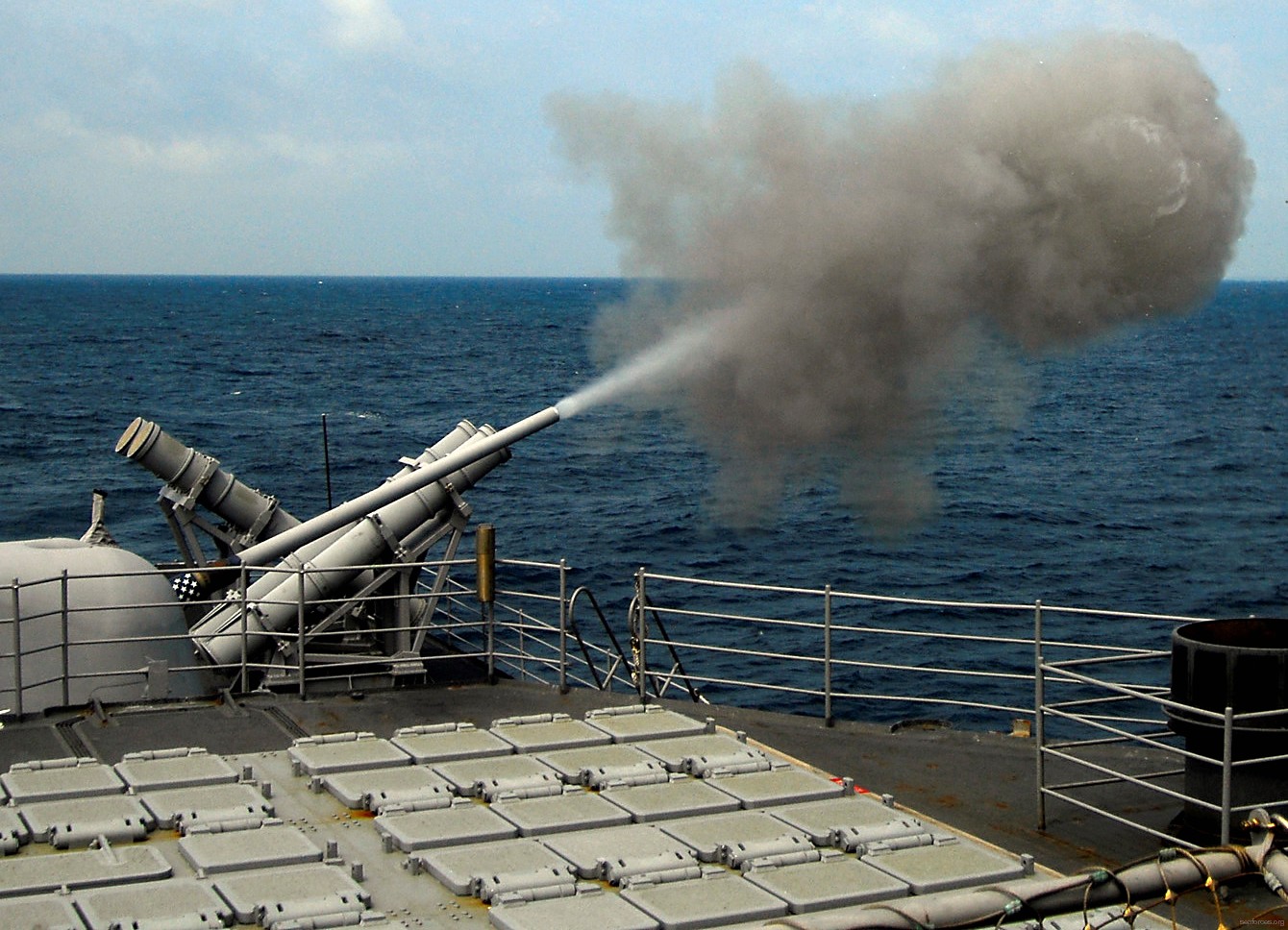 aft Mk-45 Mod.2 5-inch gun fire - Atlantic Ocean - July 2008  Mk-41 VLS maintenence - Atlantic Ocean - July 2008  Atlantic Ocean - July 2008  Atlantic Ocean - July 2008  replenishment at sea (RAS) - Atlantic Ocean - July 2008  helm - Atlantic Ocean - July 2008  Atlantic Ocean - July 2008  Naval Station Norfolk, Virginia - July 2008  Port Everglades Fleet Week, Florida - April 2008  returning to Naval Station Norfolk, Virginia after a 6-month deployment - July 2007  Arabian Sea - April 2007  departing Naval Station Norfolk, Virginia - January 2007  departing Naval Station Norfolk, Virginia - January 2007  departing Naval Station Norfolk, Virginia - January 2007  departing Naval Station Norfolk, Virginia - May 2006  Arabian Gulf - June 2004  Arabian Gulf - June 2004  Arabian Gulf - June 2004  MK-15 close-in weapon system (CIWS) fire exercise - Arabian Gulf - April 2004  Arabian Gulf - March 2004  Arabian Gulf - March 2004  Gulf of Aden - February 2004  Souda Bay, Greece - February 2004  Mediterranean Sea - February 2004  Mediterranean Sea - February 2004  Mediterranean Sea - January 2004  control console in the combat information center (CIC) - November 2003  exercise BALTOPS 03 - Baltic Sea - June 2003  exercise BALTOPS 03 - Baltic Sea - June 2003  Atlantic Ocean - March 2002  Atlantic Ocean - February 2002  Operation Enduring Freedom - January 2002  Operation Enduring Freedom - January 2002  Operation Enduring Freedom - January 2002 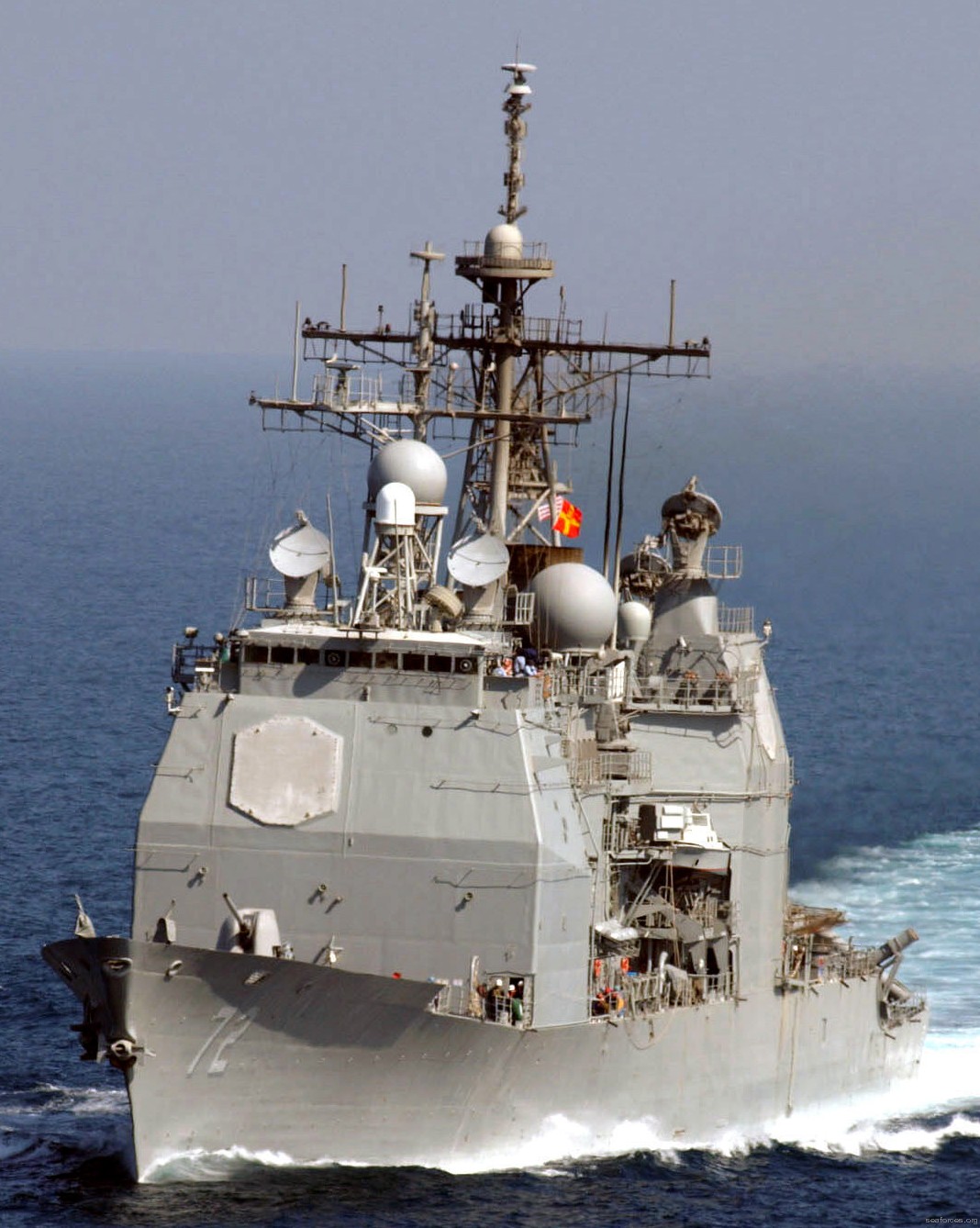 Operation Enduring Freedom - November 2001  Naval Station Norfolk, Virginia - October 1993  sea trials - April 1993  sea trials - April 1993  sea trials - April 1993  sea trials - April 1993  sea trials - April 1993  sea trials - April 1993  sea trials - April 1993 
 sea trials - April 1993  outfitting at Ingalls Shipbuilding, Pascagoula, Mississippi - April 1993  outfitting at Ingalls Shipbuilding, Pascagoula, Mississippi - March 1993 |
||
|
USS Vella Gulf (CG 72): The second Vella Gulf (CG 72) was laid down on 22 April 1991 at Pascagoula, Miss., by Litton Industries, Ingalls Shipbuilding Division; launched on 13 June 1992; sponsored by Mary A. McCauley, wife of Vice Adm. William F. McCauley (Ret.); and commissioned alongside Pier 12, Naval Operating Base (NOB) Norfolk, Va., on 18 September 1993, Capt. Constantine L. Xefteris in command. Vella Gulf loaded her ammunition at Naval Weapons Station, Earle, N.J. (22-23 September), then visited New York City (23-26 September). The crew participated in a patriotic gala, “Salute to Freedom,” on board Intrepid (CVS 11) Sea, Air, and Space Museum (24 September). The NBC New York Weekend Morning show broadcast live from Vella Gulf (25 September), and then Fox New York’s “Good Day New York” broadcast the weather report from the cruiser (27 September). She returned to Norfolk on 28 September. 1992-1993 Vella Gulf then trained off the Virginia capes and southward toward Florida. Heavy seas caused her fuel tank bulkheads to pant, and the ship completed voyage repairs to the tanks at Litton Industries Ingalls Shipbuilding Division, Mayport, Fla. (24-26 October 1993). She steamed to Port Everglades, Fla., with Magnum 445, a Sikorsky SH-60B Seahawk of Helicopter Antisubmarine Squadron Light (HSL) 44 Detachment 8 embarked. The cruiser carried out the in-port phase of her Weapons Systems Accuracy Trials at Port Everglades (28-31 October), followed by additional acoustic and torpedo trials on the ranges at the Atlantic Undersea Test and Evaluation Center (AUTEC) off Florida and the Bahamas (1-4 November). She then completed additional tests in Puerto Rican waters, including visits to Roosevelt Roads (7-8 November) and San Juan (23-27 November). Vella Gulf concluded her training by providing naval gunfire support to the Joint Special Operations Command at the range on Vieques Island, P. R. En route her return to Norfolk, the ship operated at the Wallops Island Flight Facility, Md. (5-6 December), and reached her home port on 7 December. 1994 She made for Puerto Rican waters for additional training (11-15 January 1994), and then sailed a counter-narcotics patrol with Joint Task Force (JTF) 4 in the Caribbean through the end of the month. The ship also visited Cartagena, Colombia (27 January), and Port Everglades (3-5 February), and returned to Norfolk on 10 February. Vella Gulf trained off the Virginia capes at times in February and March, and on 4 April sailed to Pascagoula. The ship completed work at the Ingalls yard (9-11 April), ran her final contract trials in the Gulf of Mexico (11-13 April), and underwent post shakedown availability (13 April-26 June). She returned to Norfolk on 1 July. Vella Gulf accomplished deperming (11-13 July 1994), and sailed on 1 August to take part in the Maine Lobster Festival at Rockland (4-7 August), returning to Norfolk on 10 August. She made for the Caribbean for additional counter-narcotics patrols as part of JTF-4 (31 August-8 October). The ship embarked Magnum 456,a Seahawk of HSL-44 Detachment 6, embarking the first female LAMPS pilots on board the cruiser. During the ship’s operations in the Caribbean, she visited Guantánamo Bay, Cuba (3-4 September and 3 October) and Curaçao, Netherlands Antilles (30 September-2 October). A severe storm swept into 83-foot merchant vessel Mescalero off the coast of Honduras on 22 September 1994. A waterspout tore off her mast and life raft and twisted the hull, separating some of the wooden planks. The boat began to take on water and Master Frank Collins issued a distress call. Collins reached Coast Guard Communications Station New Orleans, La., which contacted Coast Guard Group 7. The group dispatched a Lockheed HC-130 Hercules from Key Largo, Fla., which flew toward Mescalero’s last reported position. The group also queried JTF-4 concerning available ships or aircraft. Vella Gulf had reached a position 119 miles from Mescalero when JTF-4 contacted the cruiser and ordered her to come about. Vella Gulf made for the stricken vessel at 25 knots, and launched Magnum 456, manned by Lieutenants Dana Gordon and Franklin, and Aviation Warfare Systems Operators 1st Class Robert Alexander and 2d Class Scott Palmer. “It was dark, raining, visibility was next to nothing making it almost impossible to spot the boat,” aircraft commander Gordon recalled. “We finally contacted them on radio and spotted a flare they fired, but the storm made it very difficult.” Mescalero foundered by the bow, and Palmer, the helo’s swimmer, dropped into the stormy water. Palmer swam to the boat, and one-by-one assisted the five crewmen to the hoist. The Seahawk hoisted the men aloft and returned them to the cruiser. Mescalero apparently sank shortly after the rescue, though no one saw the boat slip under because of the fierce weather. The five men recovered on board Vella Gulf, and Magnum 456 flew them to Grand Cayman two days later. 1995 The ship visited Port Canaveral, Fla. (1-2 January 1995), then sailed for a counter-narcotics patrol in the Caribbean, capping that duty with a port visit to Nassau, Bahamas (16-19 January) before she returned to Norfolk on 21 January. Vella Gulf accomplished maintenance and took part in a number of training exercises into the summer, including Operation Hornet’s Nest, a USMC air warfare exercise off Beaufort, S.C. (27-30 March), and Sharem antisubmarine training (27-30 April) and a Composite Training Unit Exercise (CompTuEx, 1-13 May), both in Puerto Rican waters. These exercises including support of the Lightweight Exo-Atmospheric Projectile program by acting as a primary tracking platform for a test of a kinetic kill vehicle. Vella Gulf, with two Seahawks of HSL-44 embarked, then deployed to the Arabian Gulf in company with guided missile frigate Stark (FFG 31) on 13 June 1995. She accomplished repairs at Punta Delgada, Azores (21 June), reached the Sixth Fleet the following day, and stopped at Malaga, Spain (23-27 June), and Haifa, Israel (3-6 July). The ship passed through the Suez Canal (8 July), reached the Fifth Fleet the following day, and transited the Strait of Hormuz into the Arabian Gulf (15 July). Vella Gulf anchored at Bahrain (17-22 July), where Capt. Peter W. Marzluff relieved Capt. Xefteris as commanding officer on 21 July. The cruiser then patrolled the Arabian Gulf, stopping briefly at Dubai, United Arab Emirates (UAE), (2-6 August), before resuming her patrols. Following Gulf War I, the coalition established Maritime Interception Operations (MIOs) to enforce UN Security Council Resolutions imposed against the Iraqis. The UN prohibited cargo originating from Iraq and imports not accompanied by UN authorization letters, though the food-for-oil agreement permitted the Iraqis to sell limited amounts of oil to pay for food and medicine. Vella Gulf primarily performed MIOs during her deployment, though also took part in Operation Southern Watch - the enforcement of the southern no fly zone over Iraq - and supporting Operation Vigilant Sentinel. At times, the ship controlled Grumman F-14A Tomcats of Fighter Squadron (VF) 213, and McDonnell Douglas F/A-18C Hornets of Strike Fighter squadrons (VFAs) 22 and 94, flying from aircraft carrier Abraham Lincoln (CVN 72). The ship conducted ‘carrier shotgun’ operations with Abraham Lincoln (15-18 August 1995), then continued to patrol the Arabian Gulf, punctuating her routine by visiting Dubai (26 August-8 September), Bahrain (20-24 September), and Dubai again (6-12 October). Sister ship Vicksburg (CG 69) relieved Vella Gulf on 21 October. Vella Gulf’s Visit, Board, Search and Seizure (VBSS) team boarded and inspected a total of nine ships while performing MIOs during the deployment. The guided missile cruiser came about, accomplished repairs at Jiddah, Saudi Arabia (28 October 1995), then passed through the Suez Canal (1 November). She operated with the Sixth Fleet in the Mediterranean, and carried out shallow water upgrades to the AN/SQS-53C sonar with the Spanish Navy while anchored at Alicante, Spain (5-7 November). The cruiser passed through the Strait of Gibraltar (8 November), visited Rota, Spain (8-10 November), embarked her Tigers (sons of crewmembers) at Bermuda (18 November), and returned with guided missile frigates Halyburton (FFG 40) and Stark to Norfolk on 21 November. 1996 The cruiser carried out maintenance and trained off the Virginia capes and southward to Florida through the summer. Capt. James W. Phillips relieved Capt. Marzluff as the commanding officer on 8 June 1996. Vella Gulf concluded a CompTuEx off Puerto Rico and Cherry Point, N.C. (8 August-19 September). The exercise included Standard SM-2 surface-to-air missile, RGM-84 Harpoon surface-to-surface missile, and Mk 46 torpedo firings, and visits to St. Croix, Virgin Islands (22-25 August), and Pensacola, Fla. (7-9 September). In addition, she test fired a BGM-109 Tomahawk Land Attack Missile (TLAM) (10 September). The ship completed a Joint Task Force Exercise (JTFEx, 11-23 October). Vella Gulf deployed to the Mediterranean and Arabian Sea on 25 November 1996. She reached the Sixth Fleet on 9 December, and then made for the Adriatic to rendezvous with aircraft carrier Theodore Roosevelt (CVN 71) for NATO Operation Decisive Endeavor, part of Operation Joint Endeavour, the implementation of the Dayton Peace Accords within Bosnia and Herzegovina and Yugoslavia (12–22 December). Vella Gulf then operated as Adriatic Red Crown, independently of Theodore Roosevelt, while she worked with a USAF Boeing E-3 Sentry airborne early warning and control aircraft to monitor the skies over the Adriatic, and over Bosnia and Herzegovina, and Yugoslavia. 1997 Vella Gulf rounded off the year by visiting Valletta, Malta (23 December 1996-3 January 1997). The cruiser returned to the Adriatic for Decisive Endeavor (3-13 January), and then came about and visited Naples, Italy (13-16 January), Cannes, France (20-26 January), and Palma de Mallorca, Spain (28-31 January). Vella Gulf participated with attack submarine Atlanta (SSN 712) in Exercise Whale Watch in the Strait of Sicily (3-7 February), and then separately in Island Thunder in the Tyrrhenian Sea (10-14 February). During Island Thunder, the ship fired more than 200 5-inch rounds supporting amphibious landings on the Sardinian coast. Following the exercises, she put in to Naples (15-17 February), Genoa, Italy (18-20 February), and Rhodes, Greece (25 February-2 March). Vella Gulf sailed with British, Greek, Italian, and Turkish ships during InvitEx, a NATO multi-warfare exercise in the Mediterranean (2-12 March 1997). The ship steamed toward the Suez Canal, stopping at Alexandria, Egypt (12-14 March), before she passed through the canal on 16 March. Vella Gulf escorted Theodore Roosevelt in the Red Sea and the Northern Arabian Gulf during Southern Watch. A second SH-60B Seahawk cross-decked from sister ship Leyte Gulf (CG 55) and embarked on board Vella Gulf while she operated with the Fifth Fleet. The cruiser also took part in an experimental theater ballistic missile defense tracking exercise. She visited Dubai (9-12 April), and then sailed from the Arabian Gulf. The ship passed through the Suez Canal on 20 April, and completed NATO exercises Eagle Arena with the Egyptian military and Poopdeck with Spanish forces in the Mediterranean (20-30 April). Vella Gulf visited Palma de Mallorca (1-9 May) before turning for home. Aircraft carrier John F. Kennedy (CV 67) relieved Theodore Roosevelt on 11 May, and Vella Gulf returned to Norfolk on 22 May. Vella Gulf trained off the Virginia capes at times during September and October 1997. On 8 October, she sailed for New England waters and visited Newport, R.I. (10-15 October). The cruiser took part in the celebration of the 200th anniversary of the launching of the frigate Constitution (21 October 1797) at Boston, Mass. (17-21 October), before returning to Norfolk on 24 October. Additional training in the Atlantic and off the Virginia capes included a visit to Savannah, Ga. (1-3 November). 1998-1999 Capt. Brian G. Schires relieved Capt. Phillips as the commanding officer on 24 April 1998. The cruiser trained with allied ships in the Baltic (1 May-30 June). The ship spent 14 days at sea to accomplish the Total Ship Training Availability I and II, and to evade Hurricane Bonnie (mid-late August). She took part in a Second Fleet exercise that included a visit to St. John, Virgin Islands (November). Capt. Richard A. Feckler relieved Capt. Schires as the commanding officer on 16 December 1999. 2000-2001 The ship completed an overhaul at Marine Hydraulics International shipyard, Norfolk (1 January-30 June 2000). The cruiser also hosted the Spanish training ship El Juan Sabastian Elcano during Operation Sail 2000 (16 June). Vella Gulf accomplished a variety of training and upkeep requirements following her overhaul. In addition, the British Broadcasting Corporation visited the ship to support a Discovery Channel documentary on AEGIS-equipped warships (10 August). She visited New York City (5-10 November), and then participated in a series of missile and torpedo firing exercises off the Maryland coast (12-15 November). The training included the ship’s first firing of the Mk 53 Nulka Decoy Launching System. Vella Gulf visited Tampa, Fla. (18-22 January 2001). The ship completed a drydock and ship availability at Metro-Marine, Portsmouth, Va. (14-28 February). She then worked-up with Theodore Roosevelt but discovered additional problems that necessitated a return to Metro-Marine (1-7 March). HSL-48 Detachment 5 embarked on board (3 March). Following her second period of yard work, Vella Gulf trained off the Virginia capes (8-20 March), that included operating as the air defense commander during dual aircraft carrier operations with George Washington (CVN 73) and Theodore Roosevelt (10 March). The cruiser sailed for training off the east coast on 25 April 2001, and took part in Broward County Navy Days at Port Everglades (30 April-3 May). She completed a CompTuEx (1-30 June) and a series of exercises off the east coast and in the Caribbean during the summer, including a visit to Roosevelt Roads (2-4 August), and a Joint Task Force Exercise (JTFEx, 10-18 August). Al-Qāidah terrorists attacked the U.S. on 11 September 2001. Within four hours of receiving notification of the attack, Vella Gulf emergency sortied into the eastern Atlantic. She then received orders to assume North Eastern Air Defense Commander (ADC). She established tactical data links and radar coverage and helped coordinate fighter combat air patrols over Boston, New York, and Washington, D.C., and developed command and control communications for the support and execution of homeland defense and air traffic control (11-14 September). Vella Gulf loaded her final supplies of ammunition for deployment on 17 September 2001. Theodore Roosevelt sailed on 19 September, but Vella Gulf, with HSL-48 Detachment 5 embarked, sailed on Deployment 03-01 on 21 September, and made speed to rendezvous with the carrier. The ships passed through the Strait of Gibraltar overnight on 1 October. The cruiser visited Dukahyla, Egypt (9-11 October), and then participated in NATO exercise Bright Star 01/02 (12-23 October). The massive exercise involved more than 74,000 servicemembers from 44 countries. The scenarios included live-fire training, amphibious and desert operations, and force-on-force war games, and had been scheduled prior to the terrorist attacks. Vella Gulf visited Souda Bay, Crete (24-27 October). The ship passed through the Suez Canal on 29 October 2001, through Bab el-Mandeb on 1 November, and the Strait of Hormuz (11 November). A flag that flew over the World Trade center in New York was flown out to Vella Gulf, and on 13 November the ship raised the colors. Journalists from WTKR News Channel 3 from Norfolk embarked overnight to report the event (13-14 November). Vella Gulf relieved guided missile cruiser Princeton (CG 59) as the TF 50 (alternate) ADC (15-19 November), and assumed the task force’s ADC for Operation Enduring Freedom on 23 November. In addition, the ship functioned as the Force Over-the Horizon Track Coordinator on 7 December. A Navy Morale, Welfare and Recreation Holiday show starring celebrity Jessica Simpson performed for the ship on 22 December, and journalists from ABC News “Nightline” embarked (28-30 December). 2002 The ship sailed through the Strait of Hormuz and entered the Arabian Gulf on 6 January 2002. She visited Al Manama, Bahrain (13-16 January), and then came about and passed through the Strait of Hormuz on 17 January. Vella Gulf turned over her duties as TF 50 ADC for Enduring Freedom on 25 January. Capt. Ralph M. Rikard, Jr., relieved Capt. Feckler as the commanding officer on 28 January. The cruiser assumed duties as the MIO/Leadership Interdiction support ship on 3 February. Allied planners concerned about the escape of terrorists via ships from Afghanistan developed Leadership Interception Operations to catch suspicious vessels sailing off the Iranian and Pakistani coasts. Vella Gulf intercepted coastal tanker Lina, of undetermined registry, in the Gulf of Oman (16-19 February 2002). Lina had previously smuggled Iraqi oil, but the modified and reinforced locking measures fitted around the tanker had delayed a coalition boarding party from entering and taking control of the ship prior to her escape into territorial waters. In this instance, Lina disregarded repeated bridge-to-bridge queries. Vella Gulf radioed an Iranian vessel for assistance, and the Iranian ship compelled the smuggler to enter international waters. The cruiser intercepted Lina, but the tanker attempted to ram her. Vella Gulf backed and avoided a collision as the ships passed at a range of 150 yards. The ship dispatched her VBSS team, which included an eight-man Coast Guard Law Enforcement Detachment (LEDET), to board and inspect the suspect. Lina maneuvered threateningly, and a Seahawk covered the sailors while they boarded. Reinforced and welded entrances further impeded the boarders, but they secured the ship and detained 21 crewmembers. None of the boarders sustained injuries during the non-compliant boarding, and the Americans towed Lina to a holding area in the Arabian Gulf. Further investigation and inspection revealed that Lina operated as a communications ship to guide smugglers. The ship escorted Theodore Roosevelt through the Strait of Hormuz on 23 February 2002. She visited Bahrain (24-28 February), and escorted Theodore Roosevelt when the carrier came about and returned through the Strait of Hormuz to the Arabian Sea on 28 February. Vella Gulf steamed through Bab el-Mandeb on 5 March and through the Suez Canal on 8 March. Theodore Roosevelt also passed through the Suez Canal. Earlier in the cruise, Lt. Clarence J. Ervin of Vella Gulf had shifted to Theodore Roosevelt to monitor airspace during strikes over Afghanistan. Ervin disappeared from the carrier just after roll call as she crossed the Mediterranean. Two Seahawks of Helicopter Antisubmarine Squadron (HS) 11 launched from the carrier, and an SH-60B flying from the cruiser searched into the next day, but the helos failed to locate the man overboard. Egyptian sailors discovered Ervin’s body in the water near Port Sayeed Lighthouse on 13 March. Vella Gulf visited Valletta (11-15 March), sailed through the Strait of Gibraltar and reached the Second Fleet on 18 March, and returned to Norfolk on 25 March. Vella Gulf completed a Board of Inspection and Survey inspection (24-28 June 2002), followed by a dry dock availability and repairs at Newport News Shipyard, Newport News, Va. (1 July-27 September). The ship served as an opposition force against aircraft carrier Harry S. Truman (CVN 75) during a JTFEx (28 October-5 November 2002). 2003 The ship sailed to the Baltic (24 May 2003), visited Gydnia, Poland (5 June), and trained with guided missile destroyer Ross (DDG 71) and the British, Danes, Estonians, Finns, French, Germans, Latvians, Lithuanians, Poles, Russians, and Swedes during Baltic Operations 2003 (5-23 June). A Russian Kamov Ka-27 Helix, operating from guided missile destroyer Nastoychivyy (DDG 610), landed on board Vella Gulf several times and refueled once from the cruiser, marking the first time that a Russian helicopter accomplished these evolutions on board the ship (15 June). The exercise also included the opportunity to track two diesel-powered attack submarines - Polish Orp Sep (SSC 295) and Swedish Hälsingland. Vella Gulf visited Kiel, Germany (20-23 June), before she returned to Norfolk on 3 July. Capt. Michael D. Davis relieved Capt. Rikard as the commanding officer on 9 July 2003. Vella Gulf shifted berths at Norfolk to change out her No. 1B Gas Turbine Engine (11 August). Hurricane Isabel devastated areas of the Gulf and East Coasts of the U.S. during the summer, and on 16 September Vella Gulf emergency sortied to escape the tempest. The ship completed a CompTuEx (13 November-19 December), that including participating in the SinkEx (sinking) of decommissioned and stricken destroyer tender ex-Yosemite (AD 19) on 18 November. 2004 Vella Gulf deployed to the Mediterranean and Arabian Gulf on 20 January 2004, and reached the Sixth Fleet on 24 January. She cross-decked with Canadian frigate Toronto (FFH.333), (27-29 January), and passed through the Strait of Gibraltar on 1 February. The cruiser visited Souda Bay (6-10 February) and sailed through the Suez Canal on 16 February. Vella Gulf transited the Bab el-Mandeb on 20 February, and passed through the Strait of Hormuz on 28 February. She often served as the ADC for George Washington during Operation Iraqi Freedom, and Capt. Davis reported that Vella Gulf carried out her motto of “Move swiftly and strike vigorously.” The cruiser came about for “urgent missing tasking” and passed through the Strait of Hormuz on 11 March to operate in the Gulf of Oman and Indian Ocean, returning through the strait on 15 March. Vella Gulf fought in Iraqi Freedom, then visited Dubai (24-29 March). Al-Qāidah attacked the Iraqi offshore infrastructure in the Northern Arabian Gulf on 25 April 2004. At 1730, coastal patrol craft Firebolt (PC 10) launched a Rigid Hull Inflatable Boat (RHIB), manned by seven sailors, to enforce a security zone around the Iraqi Khawr Al Amaya Oil Terminal. Suicide bombers steered an explosives-rigged dhow at the terminal, but the RHIB turned to intercept the dhow. The terrorists abruptly turned their boat toward the RHIB and at 1816 triggered their explosives alongside, capsizing the RHIB. Sixteen minutes later, two other boats sped toward Panamanian-flagged tanker Takasuzu, moored at the Al Basra Oil Terminal. Task Force Shield (the garrison) opened small arms fire on the attackers. The first boat exploded alongside Takasuzu without appreciably damaging the tanker. The second boat struck the tanker to starboard but failed to explode, and broke up and sank. The attack killed three of the sailors on board the RHIB: 27-year-old Boatswain’s Mate 1st Class Michael J. Pernaselli, USN, 28-year-old Signalman 2d Class Christopher E. Watts, USN, and 24-year-old Damage Controlman 3d Class Nathan B. Bruckenthal, USCG. The explosion also wounded all of the other men on board: Operations Specialist 1st Class Alan R. Daily, USN, Communications Technician 2d Class Nathan D. Kisner, USN, Engineman 3d Class Timothy A. Carlton, USN, and 23-year-old Boatswain’s Mate 3d Class Joseph T. Ruggiero, USCG. The Navy sailors served with coastal patrol craft Firebolt (PC 10) and Thunderbolt (PC 12), and the Coast Guardsmen with LEDET 403, Tactical Law Enforcement Team South, Coast Guard Patrol Forces Southwest Asia. Two HH-60Hs of HS-5 flying from George Washington, an Australian Sikorsky S-70B-2 Seahawk operating from frigate Stuart (FFH.153), and an MH-60S of Helicopter Combat Support Squadron (HC) 6 Detachment 6, embarked on board Supply (T AOE 6), evacuated the wounded men to Kuwait Military Hospital. George Washington also launched one Tomcat, one Hornet, three Lockheed S-3B Vikings of Sea Control Squadron (VS) 31, and one Grumman E-2C Hawkeye of Carrier Airborne Early Warning Squadron (VAW) 121 that patrolled over the Northern Arabian Gulf and southern Iraq for additional terrorists, and searched for other possible survivors of the attack blown into the water. A land-based Lockheed P-3C Orion of Patrol Squadron (VP) 47 diverted from another flight and supplemented these patrols. Vella Gulf patrolled the Arabian Gulf when the attack occurred, and she made speed to reach the area. The cruiser coordinated and controlled the aircraft operating from George Washington, and also launched a Seahawk that protected the oil platforms. Additional vessels that reinforced the patrols in the area included guided missile cruiser Yorktown (CG 48), patrol craft Chinook (PC 9), Coast Guard cutters Adak (WPB 1333) and Wrangel (WPB 1332), and fleet ocean tug Catawba (T ATF 168). The cruiser came about and resumed her participation in Iraqi Freedom, punctuating her operations with visits to Jebel Ali, UAE (7-12 May and 11-15 June 2004). The ship passed through the Strait of Hormuz on 3 July, and turned over her duties to John F. Kennedy and her consorts two days later. She transited Bab el-Mandeb on 8 July, the Suez Canal on 11 July, and visited Valletta (13-16 July). Vella Gulf passed through the Strait of Gibraltar on 18 July, and returned to Norfolk on 26 July. During her deployment, the ship’s VBSS team boarded and inspected about 100 vessels, ranging in displacement from tankers to dhows. The ship then visited Port Everglades (4-7 October 2004). 2005 Vella Gulf completed two maintenance availabilities at Marine Hydraulics (19 January-22 March 2005 and 27 June-10 September 2005), including the enhancement of the Ship’s Signal Exploitations Space and replacement of the sonar dome. Capt. Stephen F. Davis, Jr., relieved Capt. Michael D. Davis as the commanding officer on 19 August. On 12 September, Capt. Davis relieved 47-year-old Command Master Chief Hospital Corpsman William Sidwell because of “fraternization” with a female junior enlisted sailor - she was reassigned to a different command. Vella Gulf trained off the Virginia capes (3-17 November 2005). While the ship crossed Chesapeake Bay en route to the Naval Academy, Capt. Russell S. Crenshaw, USN (Ret.), spoke to the crew during an all-hands call. Crenshaw had served as the executive officer and antisubmarine warfare officer on board destroyer Maury (DD 401) during the Battle of Vella Gulf, and he offered naval combat lessons from his experience. The ship then visited the Naval Academy (4-7 November) and Mayport (11-14 November) before returning to Norfolk. 2006 The cruiser sailed on 18 January 2006, served as a school ship at the Surface Warfare Officer’s School at Newport (23-27 January), and returned to Norfolk on 2 February. She then made for Charleston, S.C., on 8 March, and visited that city (10-13 March) before operating as an opposition force against aircraft carrier Enterprise (CVN 65) during a CompTuEx (14-20 March). Vella Gulf completed a Board of Inspection and Survey inspection during the first week of May. The ship operated as part of Commander Carrier Strike Group 10 (17 May-6 July 2006). She embarked Aircraft No. 455 and Aircraft No. 456, two SH-60Bs of HSL-44 Detachment 1, and sailed to take part in Baltic Operations 2006 on 17 May. That same day, two Dutch sailors, 47-year-old Robert Dirven and 50-year-old Johan Aarden, put to sea in their 41-foot sloop from Connecticut for the Azores. Fierce weather struck the boat, and 55-knot winds ripped four sails and the rigging (21-22 May 2006). The engine and bilge pumps incurred problems, the men became dehydrated, and Dirven fell down a ladder and cracked a rib. They radioed their distress to the Norfolk Coast Guard Rescue Coordination Center, which alerted Vella Gulf. When the cruiser received the message at 1030 on 22 May 2006, she had reached a position about 1,300 miles east of Boston and 62 miles from the stricken boat. She immediately came about and raced to the position. Ensign Greg Page, officer in charge, Chief Petty Officers Chaney Warrior and Steve Fortner, and Petty Officers 2d Class Aaron Haight and Greg Moon, manned a RHIB and fought 10 to 20 foot seas and 25 knot winds and rescued both mariners. The RHIB, reinforced by Petty Officer 2d Class Justin Smally, returned to the sailboat when the weather calmed and scuttled her in 2,000 fathoms of water to prevent a hazard to navigation. The cruiser then continued on to the Baltic. The multi-national exercise emphasized the initiative for Partnership for Peace amongst the Baltic nations, and comprised 2,000 people, 15 ships, two submarines, and 30 aircraft from the British, Danish, French, German, Latvian, Polish, Russian, and Swedish forces. Vella Gulf visited Karlshamn, Sweden (2-4 June 2006), Kiel (16-20 June), Gydnia (21-25 June), and Portsmouth, England (28 June), and returned to Norfolk on 6 July. She took part in JTFEx 06-2 Operation Bold Step off the east coast (21-31 July 2006). The multinational exercise comprised more than 16,000 servicemembers and 30 ships and submarines from five countries. The principal U.S. ships included aircraft carriers Dwight D. Eisenhower (CVN 69) and Theodore Roosevelt, and amphibious assault ships Bataan (LHD 5) and Wasp (LHD 2). Allied vessels included Colombian attack submarine Tayrona (SS 29) and French attack submarine Emeraude (S 604). Soldiers of the Army’s 34th Infantry Division and the Canadian 8th Brigade group made up the Combined Coalition Force Land Component Command during the exercise. Vella Gulf next completed integration training with the Bataan Expeditionary Strike Group, comprising Bataan, amphibious transport dock Shreveport (LPD 12), dock landing ship Oak Hill (LSD 51), guided missile destroyer Nitze (DDG 94), guided missile frigate Underwood (FFG 36), and attack submarine Scranton (SSN 746) off the east coast (16-26 August 2006). The ship visited Mayport (9-11 September 2006), took part in antisubmarine exercise Seawiti, and returned to Mayport (16-18 September). The ship rendezvoused with Bataan and provided nighttime fire support for marine spotters at Camp Lejeune, N.C. She then accomplished a continuous maintenance availability at Norfolk (25 September-13 October), followed by additional training with Bataan off Cherry Point (23 October-12 November). 2007 Vella Gulf deployed with the Bataan Expeditionary Strike Group (Bataan, Shreveport, Oak Hill, Nitze, Underwood, and Scranton) to the Mediterranean and Indian Ocean on 4 January 2007. The amphibious ships embarked the 26th Marine Expeditionary Unit (Special Operations Capable). Vella Gulf reached the Sixth Fleet on 10 January, and sailed through the Suez Canal and entered the Central Command on 30 January. She carried out Maritime Security Operations (MSOs), which provided security and stability in the region. A Bell UH-1N of Marine Medium Helicopter Squadron (HMM) 264 crashed while taking part in exercise Edged Mallet ’07 with Kenyan forces at Naval Station Manda Bay, Kenya. The accident injured two of the six marines on board the Iroquois, but other marines rescued and evacuated all six of the men to Bataan. Vella Gulf passed through the Suez Canal on 1 June, visited Rota (14-20 June), and returned to Norfolk on 3 July. Capt. Mark D. Genung relieved Capt. Davis as the commanding officer on 10 August 2007. 2008 The ship took part in Fleet Week at Port Everglades during late April and early May 2008. Vella Gulf, with HSL-42 Detachment 1 embarked, deployed as part of the Iwo Jima (LHD 7) Expeditionary Strike Group to the Mediterranean and Indian Ocean on 26 August 2008. The ship carried out MSOs and supported Iwo Jima during those evolutions. Pirates seized Belize-flagged roll-on roll-off ship Faina, operated by Kaalbye Shipping Ukraine, off the coast of Somalia on 25 September 2008. The vessel carried an estimated $30 million of Russian military equipment. The ship’s master reportedly suffered a fatal heart attack shortly after being taken hostage, and the pirates held Faina and her surviving 20 crewmen near Hobyo, Somalia. Vella Gulf operated as the on-scene commander (OSC) and led a variety of coalition ships and aircraft that monitored the pirates around the clock. “Our successful mission as the OSC of the M/V Faina crisis was the longest and most challenging [of the deployment]…” the cruiser’s commanding officer, Capt. Genung, recounted, “…in what became a highly-complex ransom negotiation process.” The captain noted that Vella Gulf’s operations prevented the pirates from smuggling the arms on board Faina into Somalia and saved the crewmembers. “We de-escalated several tense situations when the pirates made credible threats to the Faina hostages and Vella Gulf.” 2009 Vella Gulf relieved amphibious transport dock San Antonio (LPD 17) as the flagship of Combined TF 151, a multinational task force that conducted counter-piracy operations in the Gulf of Aden, Red Sea, Arabian Sea, and Indian Ocean, on 4 February 2009. Rear Adm. Terence E. McKnight broke his flag in command of the force in the cruiser. The following day, the pirates released Faina - purportedly after receiving a ransom payment. Sailors from guided missile destroyer Mason (DDG 87) boarded Faina and provided food, water, and medical support to the survivors, while Catawba refueled the ship and replenished her fresh water supply. Piracy continued unabated. Brigands attacked Marshall Islands-flagged motor vessel Polaris in the Gulf of Aden, and she issued a distress call at 1500 on 11 February 2009. Vella Gulf came about, made speed for the area, and captured seven pirates. At 1600 the following day, additional pirates in a skiff fired at Indian-flagged Prem Divya and attempted to board the merchantman. A Seahawk flying from Vella Gulf raced to the area and signaled for the skiff to stop. The pirates continued and the helo fired a warning shot, which the pirates also ignored. The Seahawk then fired a second warning shot and the skiff stopped. VBSS teams from Vella Gulf and Mason boarded the boat and apprehended nine more pirates, together with their weapons, including a rocket propelled grenade launcher. The cruiser transferred the 16 pirates to a temporary holding facility on board the dry cargo ship Lewis and Clark (T AKE 1). Vella Gulf subsequently came about, passed through the Suez Canal, and in early March 2009 visited Haifa. The ship returned to Norfolk on 27 March. Capt. Mark S. Young relieved Capt. Genung as the commanding officer on 23 April. The following month, the ship took part in Fleet Week at New York. She completed a selected restricted availability at BAE Systems, South Norfolk (late 2009-March 2010). 2010 Vella Gulf participated in Joint Warrior 10-1 in northern European waters (29 March–7 May 2010). The exercise included visits to Faslane, Scotland, and ports in Poland and Norway. The ship incurred engineering problems during the cruise, and conducted emergency repairs in dry dock at BAE Systems, South Norfolk (10 May-23 June). Vella Gulf deployed to the Mediterranean on 8 July 2010. The ship visited Rota on 17 July, and then sailed through the Strait of Gibraltar and put in to Augusta Bay, Sicily (21-26 July). The cruiser provided ballistic missile defense across the eastern Mediterranean, punctuating her patrols with visits to Haifa (29-31 July, 1-3 August, 8-12 August, and 25 August), Limassol, Cyprus (7-10 September), Bodrum, Turkey (22-25 September), Haifa (4 October), Souda Bay (13-22 October), Haifa (4-9 November), and Kusadasi, Turkey (24-27 November). Vella Gulf next visited Rhodes, Greece (7-12 December), where heavy winds and seas pulled bollards from the pier, compelling the ship to carry out an emergency sortie. She then visited Souda Bay (22-30 December). 2011 Relieved of her Sixth Fleet duties by guided missile destroyer Stout (DDG 55), Vella Gulf returned to Norfolk on 15 January 2011, where Capt. Mark W. Harris relieved Capt. Young as the commanding officer on 28 January The ship trained primarily for ballistic missile defense and accomplished upkeep throughout the year. Vella Gulf extended her operations during one of these training exercises to evade Hurricane Irene in August. Vella Gulf deployed to the Mediterranean on 3 January 2012. The ship visited Rota (12-16 January), where she relieved guided missile destroyer Ramage (DDG 61) of her ballistic missile patrols in the Sixth Fleet. The cruiser then sailed through the Strait of Gibraltar, visited Souda Bay (20 January), and the following day passed through the Strait of the Dardanelles, the Sea of Marmara, and the Bosphorus, and entered the Black Sea. Vella Gulf trained with Romanian and Ukrainian units, and visited Constanta, Romania (22-25 January), and Sevastopol (26-30 January) and Odessa, Ukraine (31 January). 2012 The ship returned through the Turkish Straits into the Aegean Sea (4 February 2012) and entered Souda Bay (5-14 February). She participated with the British, French, Germans, Greeks, Italians, and Turks in NATO antisubmarine exercise Proud Manta (16-23 February). The ship concluded Proud Manta with post exercise briefings at Augusta Bay (26-29 August). Vella Gulf transited the Strait of Messina (11 March 2012) and completed a voyage maintenance availability at Naples (12-21 March). The cruiser visited Souda Bay (23-27 March) and then worked with the Greeks and Israelis in NATO exercise Noble Dina (27 March-5 April). The exercise included a visit to Haifa (30 March-2 April). Vella Gulf resumed her ballistic missile defense patrols and visited Souda Bay (27 April), Haifa (30 April-4 May), and Souda Bay (1-7 June and 1-5 July). The ship served as a plane guard for Dwight D. Eisenhower on 12 July. Guided missile destroyer Laboon (DDG 58) relieved Vella Gulf of her ballistic missile defense role at Souda Bay (24-26 July). The cruiser then transited the Strait of Gibraltar on 29 July, visited Rota the following day, and returned home on 11 August. Capt. Philip W. Vance relieved Capt. Harris as the commanding officer on 29 August. Tugs took Vella Gulf under tow for repairs at Titan drydock, BAE, that lasted into 2013. source: US Naval History & Heritage Command (NHHC) - Mark L. Evans - - - - - another history: The ship is sponsored by Mrs. Mary Ann McCauley and was commissioned into the Naval Service on 18 September 1993 in ceremonies at Norfolk, VA. A multi-mission ship, Vella Gulf is designed to be capable of sustained combat operations in Anti-Air, Anti-Submarine, Anti-Surface, and Strike warfare environments. Vella Gulf is employed in support of carrier battle groups, amphibious assault groups, as well as in interdiction and escort missions. Vella Gulf’s diverse combat capability is orchestrated by the Aegis Weapon System, a fully integrated electronic detection, engagement, and fire control system. Aegis enables Vella Gulf to detect, evaluate, and engage an enemy with great firepower and accuracy. The Vella Gulf successfully completed sea trials during the month of February 1998. In the months of May and June, the Vella Gulf completed a two month BALTOPS Cruise, taking part in the 26th annual maritime exercise U.S. Baltic Operations (BALTOPS) '98 in the Western Baltic Sea from June 8–June 19, 1998. During the exercise, the commander, Carrier Group Eight, commanded the exercise from the ship. Also, the ship completed an AMMO onload, LAMPS moved aboard, completed a successful C2X, and had made a port call at St.John, U. S. Virgin Island. Upon the completion of C2X, the Vella Gulf continued pre-deployment work-ups. In January 1999, after winning her fifth consecutive “Battle "E",” the ship commenced training operations while hosting the week-long course Force Air Defense Commander training. Vella Gulf’s successful completion, in February 1999, of JTFEX ’99 marked the end of a ten-month work-up. The vessel headed out for deployment to the Adriatic Sea on 26 March 1999. After a six-day transit, the Vella Gulf took her position in the Adriatic Sea and participated in everything from Tomahawk Strike Ops to Fast-track Logistics Ops as part of Operation Noble Anvil. In May and June, the Vella Gulf continued to participate in support of combat operations, shot Tomahawks, assumed warfare commander duties (ADC, ASUWC, ASWC and Launch Area Coordinator), and conducted numerous at-sea refueling and stores replenishment events until the relaxation of weapons posture and cessation of hostilities. Vella Gulf began the month of August engaged in multi-ship exercises. She participated in DIVTACS, LeapFrogs, Tomahawk exercises, submarine exercises, Flight Ops, and Gunnery exercises. The Vella Gulf returned home on 22 September 1999 and went in November to Yorktown, VA for a complete weapons offload. As part of the George Washington Carrier Battle Group (CVBG), and in response to the terrorist attacks of September 11, 2001, the ship set sail in support of defense and humanitarian efforts off the coast of New York. Only a week later, she deployed as part of the Theodore Roosevelt Carrier Battle Group, to the Mediterranean, and South-Asia in support of Operation Enduring Freedom. The Roosevelt Carrier Battle Group transited the Suez Canal on 13 October and arrived in the Arabian Sea on 15 October, before returning home in April 2002. Deployment 2007 On 5 January 2007, Vella Gulf departed on a six month cruise as part of the Bataan Expeditionary Strike Group (BATESG). She conducted operations in the Persian Gulf, Northern Arabian Sea with French Aircraft Carrier Charles de Gaulle (in support of Operation Enduring Freedom), Gulf of Oman and Gulf of Aden. She participated in multi-national exercises, including AMAN '07, hosted by Pakistan. Vella Gulf visited Agadir, Morocco and Gaeta, Italy as liberty ports and twice pulled into Manama, Bahrain. She returned to home port in Norfolk, VA on 3 July 2007. MV Faina incident off Somalia, 2008 The Vella Gulf was identified as one of the U.S. Navy ships surrounding the MV Faina, a Ukrainian-owned, Belizian-registered ship carrying 33 T-72 tanks, RPGs and other munitions, after it was seized by pirates off Somalia on 25 September 2008. Several photographs used by news services were sourced as having been taken from the cruiser. Capture of alleged pirates in Gulf of Aden On 11 February 2009 the Vella Gulf responded to a distress call from the tanker Polaris in the Gulf of Aden. The Polaris reported that pirates in a single skiff were attempting to board the tanker with ladders, though the Polaris crew was able to thwart their efforts. Upon arriving in the area, the Vella Gulf intercepted a skiff with 7 men aboard. The crew aboard the Polaris confirmed their identity as the aforementioned attackers, and the 7 were taken aboard the Vella Gulf before being transferred to the USNS Lewis and Clark for processing before being sent to Kenya for trial. Vella Gulf was involved in another action against pirates the next day on February 12 when it responded to a distress call from a merchant vessel. The Indian freighter Premdivya reported that it had been pursued by pirates and taken fire from them. The American cruiser responded by dispatching a helicopter to the scene which fired warning shots and chased the pirate skiff down. The Vella Gulf then launched a boarding party in two RHIB's and captured nine pirates, these were then sent to the Lewis and Clark as the previous batch of pirates captured by the cruiser were. 2010s In 2012 Vella Gulf Petty Officer 2nd Class Daniel Wilt sexually assaulted a female sailor while at sea, telling her he planned to kill her and dispose of her body overboard. He was sentenced to life imprisonment. In December 2015 the ship's website listed her as assigned to Carrier Strike Group Twelve. On 23 April 2017, Vella Gulf left for an eight-month deployment to support maritime security operations in the Persian Gulf." In July, she joined Carrier Strike Group 11 for three months, conducting air strikes against ISIS targets in Iraq and Syria. She returned on 15 December. source: wikipedia |
||
|
About the Battle of Vella Gulf /
Solomon Islands - August 1943: In August 1942, U.S. Marines waded ashore at Guadalcanal and began a year-long struggle to control the waters and islands nearby. The Solomon Islands were the furthest outpost of the Japanese Empire, and one of two points of entry in the Pacific for Allied forces committed to victory. The narrow body of water between Kolombangara and New Georgia Island became the route of the "Tokyo Express" - a group of Japanese destroyers that made midnight runs to resupply army garrisons engaged in the struggle against the Americans. The Battle of Vella Gulf was one of the last and most decisive battles in the Solomons campaign. Onboard USS DUNLAP (DD 384) early on 6 August 1943, captains of six destroyers met with Task Group Commanders Frederick Moosbrugger and Rodger Simpson to discuss a plan to interdict the next running of the Tokyo Express. The group was divided in two divisions of three destroyers each. USS DUNLAP (DD 384), USS CRAVEN (DD 382) and USS MAURY (DD 401) comprised Division ABLE ONE. Division ABLE TWO had USS STACK (DD 406), USS STERRETT (DD 407), and USS LANG (DD 399). In accordance with revolutionary doctrine proposed by Commander Arleigh Burke, Moosbrugger planned to have ABLE ONE attack with torpedoes first and direct ABLE TWO to attack with guns and torpedoes after the initial attack was complete. It was to be the first time that destroyers were used as an independent striking force, free from responsibilities for screening battleships and cruisers. Later that evening, the task group proceeded at 25 knots into Vella Gulf via Gizo Strait. American destroyers used their new “Sugar George” (SG) radar to find the enemy and close under cover of darkness and rain clouds. The Japanese did not have radar and relied on visual sightings to position themselves for battle. It was quickly determined there were multiple targets on a southerly course closing at nearly 30 knots. Commander Moosbrugger ordered ABLE ONE to prepare to fire twenty-four torpedoes to port. A fourth target eventually appeared and the formation maneuvered again. At 2341, the torpedoes were fired and the American crews waited for explosions. CDR Moosbrugger turned ABLE ONE to starboard to escape counter-battery fire. As the torpedoes hit, Simpson’s ABLE TWO turned to port and opened up with 5 inch guns. Both divisions then turned and closed the enemy. With two targets sinking and one burning, the American ships continued to fire on an enemy barely able to respond. The fourth Japanese destroyer, SHIGURE, escaped to the north with only minor damage. American forces experienced no combat-related damage to ships or crews. The Japanese lost three first-rate ships, 1500 soldiers and Sailors, and tons of cargo. 310 survivors washed up on nearby islands over the next few days. The enemy suffered a humiliating defeat and never again attempted to resupply through Vella Gulf. Within three months, the garrisons at Vila, Munda, and Vella Lavella surrendered and the Japanese soon evacuated their important base at Rabaul. The tide had turned and the end was in sight.  |
||
| patches + more | ||
 
 |
||
|
|
seaforces.org |
USN ships
start page | |
